Special offer. Ravel & Chausson: Piano Trios
Pascal Rogé (piano), Mie Kobayashi (violin) & Yoko Hasegawa (cello)
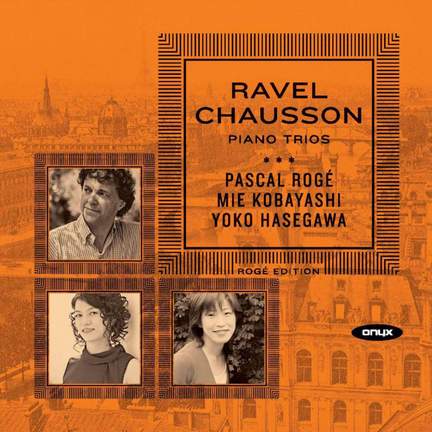
Pascal Rogé heads up this thoughtful disc of French trios. He has described his gods as Bach, Beethoven and Schumann, with Poulenc, Debussy and Satie as his friends. And so, too, are Ravel and...
Special offer. Ravel & Chausson: Piano Trios
Pascal Rogé (piano), Mie Kobayashi (violin) & Yoko Hasegawa (cello)
Purchase product

We pay more royalties to artists and composers than any other streaming service with our innovative Fair Play pay-per-second model
We pay artists and composers fairly with our pay-per-second model
Pascal Rogé heads up this thoughtful disc of French trios. He has described his gods as Bach, Beethoven and Schumann, with Poulenc, Debussy and Satie as his friends. And so, too, are Ravel and...
About
Contents and tracklist
- Pascal Rogé, Mie Kobayashi, Yoko Hasegawa
- Pascal Rogé, Mie Kobayashi, Yoko Hasegawa
- Pascal Rogé, Mie Kobayashi, Yoko Hasegawa
- Pascal Rogé, Mie Kobayashi, Yoko Hasegawa
Various Composers:
Chausson: Trio: I Pas trop lent
Work length10:29
This work is only available as an album download.
- Pascal Rogé, Mie Kobayashi, Yoko Hasegawa
I. Pas trop lent
Track length10:29
This track is only available as an album download.
- Pascal Rogé, Mie Kobayashi, Yoko Hasegawa
- Pascal Rogé, Mie Kobayashi, Yoko Hasegawa
- Pascal Rogé, Mie Kobayashi, Yoko Hasegawa
Awards and reviews
 2010
2010
Pascal Rogé heads up this thoughtful disc of French trios. He has described his gods as Bach, Beethoven and Schumann, with Poulenc, Debussy and Satie as his friends. And so, too, are Ravel and Chausson, to judge by his finely sensitive performances.
Ravel's swaying, insinuating opening theme could hardly be played more lucidly or affectionately and its final return is full of hushed magic, a far cry from smarter, more metropolitan and impersonal readings. The Pantoum is vivacious rather than aggressive and the entire performance, even in moments of heightened drama and intensity, is unforced, its sparkle gentle rather than metallic or self-consciously virtuosic.
Chausson's early Trio is remote from such ultra- Gallic refinement and sophistication, its opening Pas trop lent romantically troubled in a style clearly deriving from César Franck's recently completed Piano Quintet. The second movement Vite, on the other hand, falls like manna from heaven after so much chromatic turbulence. Both here and in the finale Chausson breaks out into a reassuring lightness which has its origins in Saint- Saëns. Such alternating solace and despair are beautifully realised by Rogéacute; and his colleagues.
The warm and fluid Onyx sound reflects performances of a quiet but unmistakable authority.