Saint-Saëns - Chamber Music
The Nash Ensemble
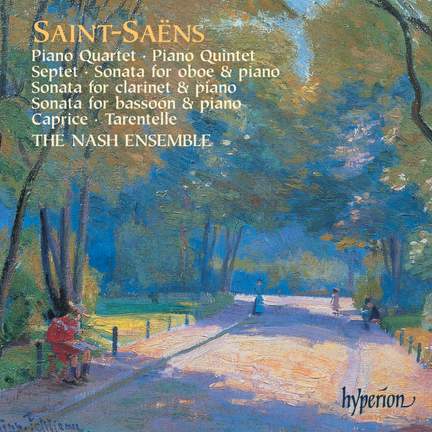
Awards:
-
BBC Music Magazine, July 2005, Chamber Choice

-
Presto Favourites, Recommended Recording

Saint-Seëns in full vigour and mastery - a wonderful pair of discs
Saint-Saëns - Chamber Music
The Nash Ensemble
Purchase product
Awards:
-
BBC Music Magazine, July 2005, Chamber Choice
-
Presto Favourites, Recommended Recording
Saint-Seëns in full vigour and mastery - a wonderful pair of discs
About
This exciting new double album from The Nash Ensemble presents an enchanting programme of chamber music by Camille Saint-Saens, that quintessential figure of nineteenth-century French music-making. At the heart of the set come the Piano Quartet and Piano Quintet, composed in 1875 and 1855, respectively. The quintet exudes a youthful confidence and swagger, the piano part leading the way, while the quartet quickly established itself as a staple of the repertory. Saint-Saens was a passionnate promoter of his own music being all too aware that the name of a contemporary composer on a concert bill represented the kiss of death and brought about many performances of his own works (and those of his contemporaries, establishing the Societe Nationale de Musique in 1871 for this purpose). One result of this passion for which we must be especially grateful was that Saint-Saens frequently wrote for the forces available, and this set opens with a rare septet for trumpet, string quintet and piano (the result of a playful commission from a chamber music society known as La Trompette), a jaunty work embracing seventeenth-century dance forms within a neoclassical style (perhaps fortunately, the composer appears never to have fulfilled his original promise to the society to compose a piece for guitar and thirteen trombones). In the last year of his life Saint-Saens set out to compose sonatas for each of the main woodwind instruments and piano. Those for cor anglais and flute were never written, but the sonatas for oboe, bassoon and clarinet here join with a tarantella (for flute, clarinet and piano) and a caprice (delightfully combining Danish and Russian themes and the sonorities of flute, oboe, clarinet and piano) to conclude the programme.
Contents and tracklist
Spotlight on this release
-
An error occurred.
Try watching this video on www.youtube.com, or enable JavaScript if it is disabled in your browser.
-
Camille Saint-Saëns
27th Mar 2015
James explores the music of French composer Camille Saint-Saëns and chooses some of his favourite recordings.

Awards and reviews
-
BBC Music MagazineJuly 2005Chamber Choice
-
Presto FavouritesRecommended Recording
 1st July 2008
Saint-Seëns in full vigour and mastery - a wonderful pair of discs
 2010
2010
Saint-Saëns's chamber music fares better in the concert hall than the recording studio, perhaps because musicians tend to listen less to academic name-calling ('conservative', 'too prolific') than to the music itself. The three late wind sonatas in particular have received far fewer recordings than their status as repertoire staples deserves.
Try the kinky-Baroque first movement of the Oboe Sonata, jauntily phrased by Gareth Hulse, or the animato second of the Clarinet Sonata, garbed in rich Mozartian cloth by Richard Hosford.
The Bassoon Sonata is notable for its fresh and gentle wit and skirting of cliché: Ursula Leveaux does it proud, with especially luscious tone in the opening Allegretto.
Surprises are fewer in the earlier works, but none is less than,'finely put together' to echo Ravel's assessment. Hummability quotient is high in the Piano Quartet and Quintet, and off the scale in the Septet. The late Lionel Salter used to complain in Gramophone that recordings of the Septet tend to sound like a trumpet concerto; not this one. If you employ hit artists like Maurice André they will tend to hog the microphone but, happily, Mark David is a more sensitive soul who's fully imbibed the Nash's joyous spirit of corporate music-making, and Hyperion's engineers have placed him at a respectable distance. If anything it's Ian Brown's piano that takes centre-stage, and that's no bad thing, except in the extensive fugal finales to the Piano Quartet and Quintet where Saint-Saëns, most unusually, seems to over-run himself. The Caprice and Tarantelle, for all Philippa Davies's sparkling contributions, perhaps bear fewer repetitions, but the set is really sheer delight: let's hear it for imaginative conservatism.

This 2-CD set of chamber music performed by the Nash Ensemble gets off to a great start with a poised, expertly-balanced performance of the Septet, and goes on to include spirited, characterful accounts of the sonatas for oboe, clarinet, and bassoon, as well as the Piano Quartet in B flat and Piano Quintet in A minor.