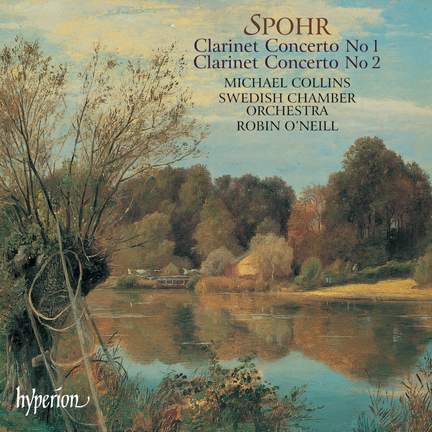
Special offer. Spohr - Clarinet Concertos Nos. 1 & 2
Michael Collins (clarinet)
Swedish Chamber Orchestra, Robin O'Neill
…the first two of his four concertos for the clarinettist Johann Simon Hermstedt… well worth hearing: they’re imaginatively constructed and full of graceful melody, as well as being true virtuoso...
Special offer. Spohr - Clarinet Concertos Nos. 1 & 2
Michael Collins (clarinet)
Swedish Chamber Orchestra, Robin O'Neill
Purchase product

…the first two of his four concertos for the clarinettist Johann Simon Hermstedt… well worth hearing: they’re imaginatively constructed and full of graceful melody, as well as being true virtuoso...
About
Louis Spohr was one of the most significant personalities in German music in the first half of the nineteenth century, equally outstanding as a composer, violinist, conductor, teacher and organizer who was considered a leading pioneer of early Romanticism. In fact he ranked during his lifetime as a member of the pantheon of great composers, his music played and loved by thousands. Gradually he slipped from this Olympian height, but in more recent decades he has enjoyed something of a revival, mainly fuelled by his delightful chamber music including the Nonet and the Octet (on Hyperion CDA66699) and the Double Quartets (on Hyperion Dyad CDD22014) and also by his numerous works for clarinet. Spohr, who was born in Brunswick on 5 April 1784 and died in Kassel on 22 October 1859, was a twenty-year-old violin virtuoso when he shot to fame after a sensational concert in Leipzig on 10 December 1804. The following year the young composer was offered the post of Music Director at the enlightened court of Gotha and, at twenty-one, he became the youngest incumbent in Germany of such a position. His Gotha employers were sufficiently worried by his youth that they publicly declared him to be a few years olderperhaps a necessary strategy when deference to age and experience was the norm. It was at Gotha in the autumn of 1808 that Spohr met the clarinet virtuoso Johann Simon Hermstedt, and the two men hit it off straight away. Spohr immediately began work on the Concerto in C minor. Hermstedt was so taken by the work thatrather than insisting on the composer modifying some of his more outlandish, and unplayable, demandshe adapted and expanded his instrument to suit the music, thus bringing about important developments in the range and flexibility of the clarinet, expanding it from five keys to thirteen. In the summer of 1810 Germanys first genuine music festival was staged in Frankenhausen and Spohr was selected as conductor, a remarkable accolade as he was by far the youngest contender for the position. Hermstedts appetite for new Spohr works was insatiable and he proposed that he should unveil a second clarinet concerto at the festival. Accordingly, Spohr got to work during the spring and the Concerto in E flat major was first performed by Hermstedt at Frankenhausen on 22 July 1810. The British clarinettist Michael Collins is one of the most sought-after and successful wind players of his generation. At the age of sixteen he won the woodwind prize in the first BBC Young Musician of the Year Competition, and at twenty-two made his American debut at Carnegie Hall, New York. Since then he has performed as a soloist with many of the worlds major orchestras and most renowned conductors. This is his first solo recording for Hyperion.
Contents and tracklist
- Michael Collins (clarinet)
- Swedish Chamber Orchestra
- Robin O'Neill
- Michael Collins (clarinet)
- Swedish Chamber Orchestra
- Robin O'Neill
- Michael Collins (clarinet)
- Swedish Chamber Orchestra
- Robin O'Neill
- Michael Collins (clarinet)
- Swedish Chamber Orchestra
- Robin O'Neill
Awards and reviews
 June 2005
…the first two of his four concertos for the clarinettist Johann Simon Hermstedt… well worth hearing: they’re imaginatively constructed and full of graceful melody, as well as being true virtuoso showpieces. Michael Collins effortlessly surmounts all their technical difficulties... with incisive attack, wonderfully liquid arpeggios and complete control even up to (sounding) top B flats...
 2010
2010
The memorable opening C minor theme of the First Clarinet Concerto (1809) has a Beethovenian contour, yet the solo roulades which follow suggest the minor key is not to be taken too seriously.
The work, like its companion, was commissioned by the clarinet virtuoso Johann Hermstedt, who adapted his instrument for the music, adding five extra keys! It is a fine piece with a lovely Adagio to remind us that Mozart's Quintet was Spohr's inspiration. The charming finale lollops along engagingly.
The Second Concerto, written a year later, is distinctly galant in the jaunty Hummelian march theme which dominates the first movement. The eloquent Adagio is unashamedly operatic, with characteristic turns in the melodic line, but the highlight is the Polacca finale, opening neatly with a solo timpani flourish answered by the horns.
This gives Michael Collins wonderful opportunities for a spirited bravura display that invites a smile of pleasure, as do his fluid, lyrical line and lovely tone and phrasing throughout.
The Potpourri opens invitingly on the horns but is no medley. Instead it centres on two themes, the second with a set of variations, offering more bravura fireworks, clearly relished here. The Variations are very much in the same vein. An outstanding disc, excellently recorded.
 November 2012
an artist of advanced musicianship allied to absolute technical command - a combination that's the preserve of few.