Clara Schumann - Piano Music
Francesco Nicolosi (piano), with Rodolfo Bonucci (violin), Andrea Noferini (cello)
Alma Mahler Sinfonietta, Stefania Rinaldi
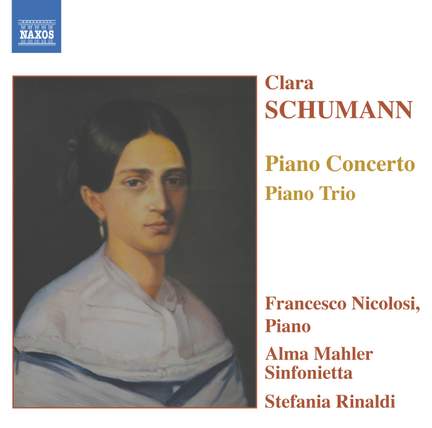
The autograph manuscript of Robert Schumann's Piano Concerto (1845) revealed not only the toil but also the hand of Clara, par- ticularly in the last movement. Eleven years earlier, Robert had...
Clara Schumann - Piano Music
Francesco Nicolosi (piano), with Rodolfo Bonucci (violin), Andrea Noferini (cello)
Alma Mahler Sinfonietta, Stefania Rinaldi
Purchase product

We pay more royalties to artists and composers than any other streaming service with our innovative Fair Play pay-per-second model
We pay artists and composers fairly with our pay-per-second model
The autograph manuscript of Robert Schumann's Piano Concerto (1845) revealed not only the toil but also the hand of Clara, par- ticularly in the last movement. Eleven years earlier, Robert had...
About
Contents and tracklist
- Francesco Nicolosi (piano)
- Alma Mahler Sinfonietta
- Stefania Rinaldi
- Francesco Nicolosi (piano), Rodolfo Bonucci (violin), Andrea Noferini (cello)
Awards and reviews
 2010
2010
The autograph manuscript of Robert Schumann's Piano Concerto (1845) revealed not only the toil but also the hand of Clara, par- ticularly in the last movement. Eleven years earlier, Robert had orchestrated a Concertsatz by the 14-year-old Clara and this became the corresponding movement of her concerto which she soon completed on her own.
The Concertsatz is as long as the other movements put together and a shorter finale might have been beneficial. Yet the complete, though imperfect, work is a notable achievement for so young a composer; and the piano part could be seen as a vehicle for virtuosity. All credit therefore to Francesco Nicolosi for not succumbing to temptation. His playing is deeptoned and tractable and, in conjunction with Stefania Rinaldi who eschews strident orchestral attack, finds a vein of melancholy in the music. He also ably balances the implied duality of the Romanze in which the marking congrazia conflicts somewhat with the additional La melodia ben marcato e legato.
'Not a gifted melodist but skilful handling of other elements compensates' is one of biographer Nancy B Reich's verdicts on Clara Schumann. And an element is the assured way modulations are treated in the Piano Trio (1846). Nicolosi adapts his playing to the demands of the genre, and he interacts sympathetically with his fine partners. Perhaps the Scherzo (to be played Tempo di menuetto) ought to have been bucolic rather than gracious but this doesn't detract from a very communicative performance. The orchestra's cellos and basses are lightweight and the solo violin occasionally squeaky but the sound is otherwise good.