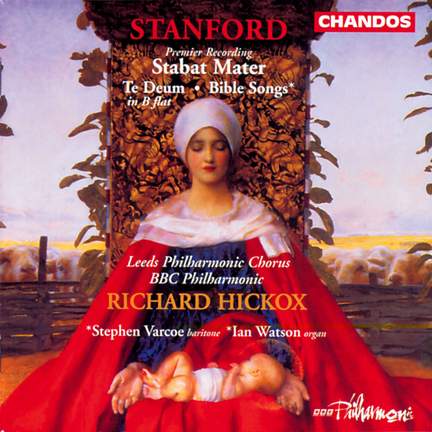
Special offer. Stanford: Stabat Mater, Op. 96, etc.
Ingrid Attrot (soprano), Pamela Helen Stephen (mezzo-soprano), Nigel Robson (tenor), Stephen Varcoe (baritone), Darius Battiwalla (organ), Ian Watson (organ)
Leeds Philharmonic Chorus, BBC Philharmonic, Richard Hickox
Writing of his old teacher in 1952, Vaughan Williams foretold that his time would come round again: 'With the next generation the inevitable reaction will set in and Stanford will come into...
Special offer. Stanford: Stabat Mater, Op. 96, etc.
Ingrid Attrot (soprano), Pamela Helen Stephen (mezzo-soprano), Nigel Robson (tenor), Stephen Varcoe (baritone), Darius Battiwalla (organ), Ian Watson (organ)
Leeds Philharmonic Chorus, BBC Philharmonic, Richard Hickox
Purchase product

We pay more royalties to artists and composers than any other streaming service with our innovative Fair Play pay-per-second model
We pay artists and composers fairly with our pay-per-second model
Writing of his old teacher in 1952, Vaughan Williams foretold that his time would come round again: 'With the next generation the inevitable reaction will set in and Stanford will come into...
About
Contents and tracklist
- Richard Hickox, BBC Philharmonic, Darius Battiwalla, Ingrid Attrot, Pamela Helen Stephen, Nigel Robson, Stephen Varcoe, Leeds Philharmonic Chorus
- Richard Hickox, BBC Philharmonic, Ingrid Attrot, Pamela Helen Stephen, Nigel Robson, Stephen Varcoe, Darius Battiwalla, Leeds Philharmonic Chorus
Awards and reviews
 2010
2010
Writing of his old teacher in 1952, Vaughan Williams foretold that his time would come round again: 'With the next generation the inevitable reaction will set in and Stanford will come into his own.' It has taken more than a generation, but at last it does begin to look as though he was right.
This recording of a 'symphonic cantata', the Stabatmater, strong in ideas, deeply felt and structurally assured, will certainly strengthen the steadily growing appreciation of his worth. The Prelude, impressive as it is, is almost too soundly constructed, and the first choral movement, rich in its Verdi-like foreground of soloists, signs off with a slightly self-conscious repetition of the opening words by the soprano. Stanford is never abashed by the prospect of melodic commitment, and the orchestral Intermezzo comes out boldly with what promises to be a good, old-fashioned Grand Tune; but then he seems to remember where he is, and the piece ends with murky explorations that seem not quite to find what they may be seeking.
The work itself ends, as Lewis Foreman suggests in his useful notes, in Eternity: 'we seem to reach the crest of a hill only to find the path stretching onward and upward to another.' The performance carries conviction, with Hickox exercising that natural rightness of his so that in a work such as this, without predecessors on record, a listener will feel that this is how it should 'go'.
Fine orchestral playing and choral singing give pleasure throughout. The solo quartet is led by Ingrid Attrot's colourful but none too evenly produced soprano, and in the Bible Songs Stephen Varcoe sings sensitively to the judiciously registered organ accompaniment of Ian Watson. The most tuneful of Te Deums follows, blithe and buoyant in its orchestrated version.