Bliss - Chamber Music Volume 2
Nicholas Daniel (oboe), Martin Outram (viola), Peter Donohoe (piano)
Maggini Quartet
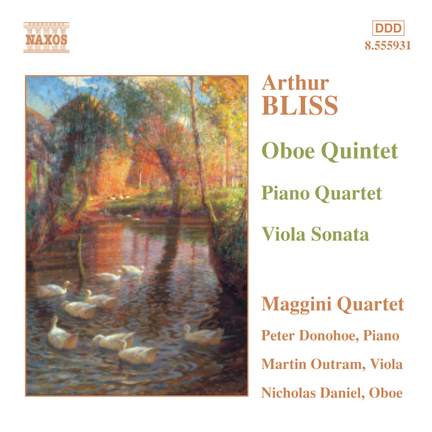
The Maggini Quartet and Peter Donohoe give a commanding performance of the Piano Quartet, locating an underlying toughness of argument and urgency of expression in both outer movements to make...
Bliss - Chamber Music Volume 2
Nicholas Daniel (oboe), Martin Outram (viola), Peter Donohoe (piano)
Maggini Quartet
Purchase product

We pay more royalties to artists and composers than any other streaming service with our innovative Fair Play pay-per-second model
We pay artists and composers fairly with our pay-per-second model
The Maggini Quartet and Peter Donohoe give a commanding performance of the Piano Quartet, locating an underlying toughness of argument and urgency of expression in both outer movements to make...
About
Contents and tracklist
- Peter Donohoe (piano), Martin Outram (viola), Laurence Jackson (violin), Michael Kaznowski (cello)
- Recorded: 18-20 December 2001
- Recording Venue: Potton Hall, Suffolk, England
- Martin Outram (viola), Julian Rolton (piano)
- Recorded: 18-20 December 2001
- Recording Venue: Potton Hall, Suffolk, England
- Nicholas Daniel (oboe)
- Maggini Quartet
- Recorded: 18-20 December 2001
- Recording Venue: Potton Hall, Suffolk, England
Awards and reviews
 2010
2010
The Maggini Quartet and Peter Donohoe give a commanding performance of the Piano Quartet, locating an underlying toughness of argument and urgency of expression in both outer movements to make one regret all the more forcefully the budding composer's decision to withdraw the piece following his demobilisation in 1919.
Otherwise unrepresented in the domestic catalogue, the Viola Sonata was written in 1933 for Lionel Tertis. If Bliss's inspiration lacks the distinctive melodic profile and organic mastery of, say, Walton's Viola Concerto of four years previously, the work as a whole is still worth getting to know. The Maggini's violist, Martin Outram, makes commendably light of the solo part's at times hair-raising demands and Donohoe offers exemplary support.
But the jewel in this anthology is the Oboe Quintet that Bliss composed in 1927 for Leon Goossens. Elegance and resourcefulness are the watchwords in the first two movements, whose bitter-sweet lyricism forms an effective contrast with the exuberant festivities of the finale.
Nicholas Daniel and the Maggini give a spry, ideally proportioned reading. Production-values throughout are of a high order. Very warmly recommended.