

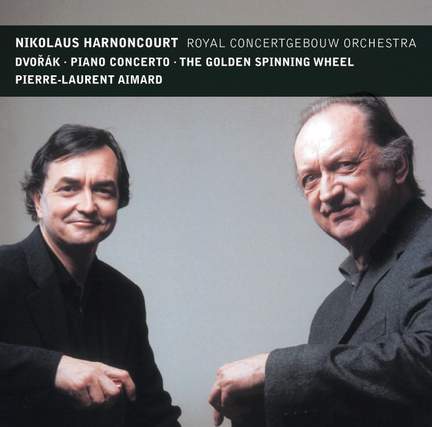
Special offer. Dvorak: Piano Concerto & The Golden Spinning Wheel
Pierre-Laurent Aimard (piano)
Royal Concertgebouw Orchestra, Nikolaus Harnoncourt
Awards:
-
Gramophone Magazine, January 2004, Editor's Choice

Straight to the top of the list for this one! Even on its best showings – Richter and Carlos Kleiber, Firkušný under Somogyi – Dvorák's Piano Concerto has never quite managed to cast off its...
Special offer. Dvorak: Piano Concerto & The Golden Spinning Wheel
Pierre-Laurent Aimard (piano)
Royal Concertgebouw Orchestra, Nikolaus Harnoncourt
Purchase product

We pay more royalties to artists and composers than any other streaming service with our innovative Fair Play pay-per-second model
We pay artists and composers fairly with our pay-per-second model
Awards:
-
Gramophone Magazine, January 2004, Editor's Choice
Straight to the top of the list for this one! Even on its best showings – Richter and Carlos Kleiber, Firkušný under Somogyi – Dvorák's Piano Concerto has never quite managed to cast off its...
About
Contents and tracklist
Dvořák:
Piano Concerto in G minor Op.33 : I Allegro agitato
Work length18:24
This work is only available as an album download.
Excerpt,Dvořák:
Piano Concerto in G minor, Op. 33
Work length20:57
This work is only available as an album download.
III Finale - Allegro con fuoco
Track length11:23
This track is only available as an album download.
Work length28:24
This work is only available as an album download.
Awards and reviews
-
Gramophone MagazineJanuary 2004Editor's Choice
 2010
Straight to the top of the list for this one! Even on its best showings – Richter and Carlos Kleiber, Firkušný under Somogyi – Dvorák's Piano Concerto has never quite managed to cast off its Cinderella rags. With this recording, the ball beckons, and there's no time limit. Granted, Brahms is still securely in the background and the concerto is hardly as pianistic as the best of its concerto-peers but the beauty of this performance is its utter naturalness, Pierre-Laurent Aimard easing around the solo part as if he's been playing it all his life, and Nikolaus Harnoncourt's sympathy for the work is obvious from the start. Together they make the most of the score's drama, giving the lie to Dvorák's supposedly ineffective piano writing. Albrecht Gaud's excellent booklet note credits the longprevalent revision by Vilém Kurz as giving the part 'not only a more effective form' but also the virtue of extra clarity. Yet it appears that the original is used here and redeemed. Richter's clarity and Firkušný's knowing accent remain attractive, but Aimard's combination of intelligence and informality win the day. A magnificent CD.
