Quantity deal. Peter Schindler: Perpetuum mobile
Songs from the Codex Buranus
SATB Choir and Ensemble (SATB/ENS)
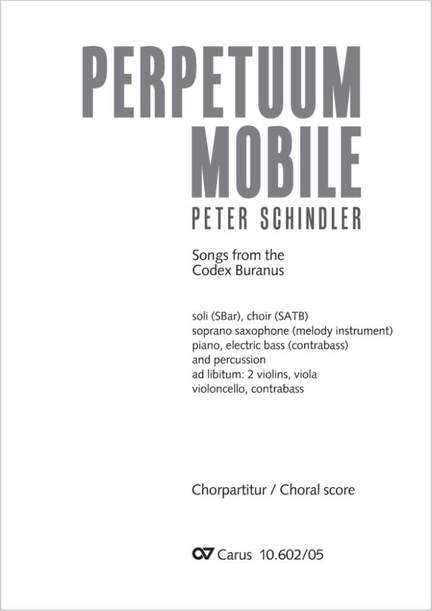
Quantity deal. Peter Schindler: Perpetuum mobile
Songs from the Codex Buranus
SATB Choir and Ensemble (SATB/ENS)
Purchase product
About
The Codex Buranus, the famous collection of medieval poems and dramatic texts from Benediktbeuern Monastery, still contains many intriguing secrets today. Who wrote the texts, for which occasions, and above all, for whom? In his work “Perpetuum mobile” composer Peter Schindler has set 44 texts from the Codex to create a new 90minute song cycle in 4 acts for soloists, chorus, jazz quartet and string ensemble (ad libitum). | The message: The title reflects the overall concept of the work: the Creation set in motion the formation of the world, which remains in motion for ever. All the events recur in evernew variations. | The music: The music uses many different styles. Homophonic movements and fugues are found alongside pop and jazzinspired pieces. Echoes of the Notre Dame style can also be heard, with influences from organum and writing in parallel fifths. The songs are for fourpart mixed choir, soprano and baritone soloists, and a jazz quartet. A string ensemble can be added to this lineup. | The texts: The 315 songs and dramatic texts from the 13th century were published completely for the first time in 1847 in an edition entitled “Lieder aus Benediktbeuern” – in Latin: Carmina burana. The contents include moralsatirical songs, spring and love songs, medieval courtly songs, and sacred dramas. The Codex Buranus is recognized as an international cultural treasure. Its importance lies in the international range of the collection, which extends beyond linguistic and cultural boundaries. It continues to impress today as an invaluable testimony to medieval culture and European history, for the texts remain breathtakingly true to the present day.
Contents
- Peter Schindler: Perpetuum mobile - Songs from the Codex Buranus