

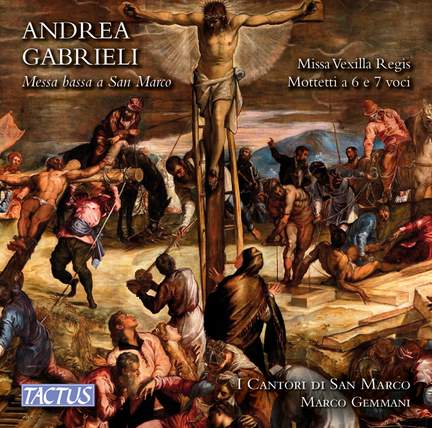
A. Gabrieli: Missa vexilla regis & Motets
I Cantori di San Marco, Marco Gemmani
The performances are lively and intelligent, and Gemmani is ever alert to the spatial effects of the music.
A. Gabrieli: Missa vexilla regis & Motets
I Cantori di San Marco, Marco Gemmani
Purchase product

The performances are lively and intelligent, and Gemmani is ever alert to the spatial effects of the music.
About
While during most of the sixteenth century vocal polyphonic music had steadily focused on a four-part structure, around the fifteen-seventies the number of parts underwent a remarkable increase, particularly in sacred music, all over Italy. In 1560 a six-part composition was still regarded as an unusual piece for special occasions, but in 1580 this number of parts was considered not very high, since in the most important festivities, music formed of eight or more parts was performed, and, particularly in Venice at the end of the century, pieces formed of no less than twenty or more parts were composed. A typical example of this case is the Concerti published by Giovanni Gabrieli in 1587, one of the cornerstone works of the musical production of the second half of the sixteenth century: many Italian and foreign composers admitted that they had obtained new ideas from this work, where the six- and seven-part pieces appeared to be the most “simple” ones, while the ten-, twelve- and sixteen-part pieces were predominant. The four-part structure, which had been customary up to a few years before, seemed to be obsolete by then. The structure of these polyvocal, often also polychoral, pieces, is not particularly complex. Their appeal consists chiefly in the pursuit of grandeur, the dynamic play of the choral masses, the restless rhythm of the sequences of chords, and the search for a sound that is rich in harmonics. We cannot be sure, on the contrary, of the liturgical use of the six- and seven- part motets contained in this collection…
Contents and tracklist
- I Cantori di San Marco
- Marco Gemmani
- I Cantori di San Marco
- Marco Gemmani
- I Cantori di San Marco
- Marco Gemmani
- I Cantori di San Marco
- Marco Gemmani
- I Cantori di San Marco
- Marco Gemmani
- I Cantori di San Marco
- Marco Gemmani
- I Cantori di San Marco
- Marco Gemmani
- I Cantori di San Marco
- Marco Gemmani
- I Cantori di San Marco
- Marco Gemmani
- I Cantori di San Marco
- Marco Gemmani
- I Cantori di San Marco
- Marco Gemmani
- I Cantori di San Marco
- Marco Gemmani
- I Cantori di San Marco
- Marco Gemmani
- I Cantori di San Marco
- Marco Gemmani
- I Cantori di San Marco
- Marco Gemmani
Awards and reviews
 May 2015
The performances are lively and intelligent, and Gemmani is ever alert to the spatial effects of the music.
