

Schütz: Musikalische Exequien, SWV 279-281 (Op. 7)
La Petite Bande, Sigiswald Kuijken
The sound is bright and compact…and the resulting interpretation has a welcome directness and clarity. It is, as they say, easy on the ear.
Schütz: Musikalische Exequien, SWV 279-281 (Op. 7)
La Petite Bande, Sigiswald Kuijken
Purchase product

The sound is bright and compact…and the resulting interpretation has a welcome directness and clarity. It is, as they say, easy on the ear.
About
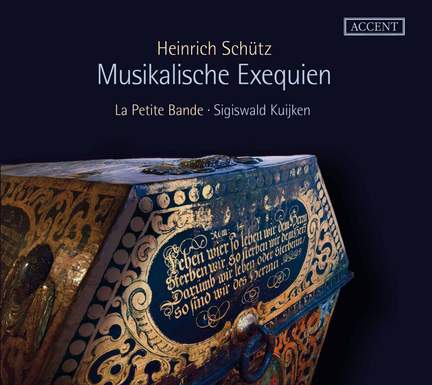
Heinrich Schütz composed the Musikalische Exequien SWV 279-281 for the funeral of his patron Prince Heinrich Posthumus Reuß 1635/1636. Of the three parts, which were to be performed during three different sections of the funeral service the first part, in the form of a sacred concerto for choir and soloists, is based on the numerous biblical passages which, in accordance with the instructions given by the deceased were to be recited at the coffin, which the deceased himself had designed during his lifetime. This part is followed by a motet for double choir based on the text of a sermon ("Herr, wenn ich nur dich habe"), and at the conclusion of the hymn of praise to Simeon ("Herr, nun lässest du deinen Diener in Frieden fahren"), a choir apart from the main choir intones "Selig sind die Toten" from heaven, so to speak. With this composition, written as a commission, Schütz created one of the most artistic and heartfelt works of mourning ever written in the history of music.
For his recording, Sigiswald Kuijken decided on a soloistic rendering of the individual parts, thus attaining greater transparency. In the middle parts, Kuijken uses high tenors – no altus or countertenors – who possess the specific ability to sing the middle parts over the entire tessitura clearly and with good balance, contributing great richness to the overall sound.
Contents and tracklist
- La Petite Bande
- Sigiswald Kuijken
- Recorded: 23-25 October 2014
- Recording Venue: Predikherenkerk, Leuven, Belgium
- La Petite Bande
- Sigiswald Kuijken
- Recorded: 23-25 October 2014
- Recording Venue: Predikherenkerk, Leuven, Belgium
- Marie Kuijken (soprano), Stephan Scherpe (tenor)
- La Petite Bande
- Sigiswald Kuijken
- Recorded: 23-25 October 2014
- Recording Venue: Predikherenkerk, Leuven, Belgium
- La Petite Bande
- Sigiswald Kuijken
- Recorded: 23-25 October 2014
- Recording Venue: Predikherenkerk, Leuven, Belgium
- Daniel Schreiber (tenor)
- Recorded: 23-25 October 2014
- Recording Venue: Predikherenkerk, Leuven, Belgium
- La Petite Bande
- Sigiswald Kuijken
- Recorded: 23-25 October 2014
- Recording Venue: Predikherenkerk, Leuven, Belgium
Awards and reviews
 October 2015
The sound is bright and compact…and the resulting interpretation has a welcome directness and clarity. It is, as they say, easy on the ear.
