Special offer. Duni: 6 Sonatas For Flute/Violin & B.c.
DuniEnsemble (performer), Leonardo Massa (performer), Claudia Di Lorenzo (performer), Natalia Bonello (performer), Vincenzo Bianco (performer)
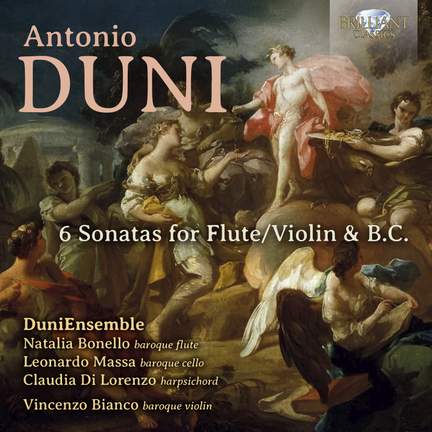
Special offer. Duni: 6 Sonatas For Flute/Violin & B.c.
DuniEnsemble (performer), Leonardo Massa (performer), Claudia Di Lorenzo (performer), Natalia Bonello (performer), Vincenzo Bianco (performer)
Purchase product
About
Antonio Duni and his better-known younger brother, Egidio, were sons of Francesco Duni, Kapellmeister of the Matera Cathedral from the early 18th century. Antonio studied music in Naples, as was the established practice at the time, and, as a composer and violinist himself, became a Kapellmeister. An extraordinary talent and restless genius, he left Naples in search of fortune, moving to Barcelona, then Vienna, then Madrid, where in 1726 he became Master of the Royal Chapel; he then moved on to Paris, Trier, and again Madrid, where in 1736 he befriended the famous singer and composer Carlo Broschi Farinelli, becoming director and choirmaster to the Duke of Osuna. By 1757, Antonio Duni could be found in Moscow, where he was commissioned by the rector of Moscow University to found the Moscow University Choir, a task that was to occupy him for more than eight years. This was followed by a short stay in Riga on the Baltic Sea, and possibly a trip to China. From 1765, he moved with his wife and four children permanently to Schwerin in Germany, where, in severe financial straits, he died around 1766.
The recent discovery of the 6 Sonatas is thanks to Thomas Suárez, a descendant of the Duni family on his mother's side, who, upon discovering a microfilm of the only printed edition in the Moscow State Library in 2019, produced the modern edition from which this recording was performed. The Sonatas were printed in Paris at the M.lle Vendôme Publishing House (most active between the years 1737–1762), and the fact that the printed manuscript was found in Moscow suggests that Antonio Duni brought it with him on beginning his stay in the Russian capital (1757–65), suggesting the composition of the sonatas predates 1757.
The six sonatas each feature four movements in the Corellian pattern, Lento–Veloce–Lento–Veloce. The melodic line presents cantabile themes that are never banal or "mannered," characterized by a strikingly original creativity on harmonic, phraseological, and formal levels. The extremely precise articulation indications and passages modulating to keys not often frequented in the Baroque period make for challenging and interesting interpretative work. Taking up the subtitle's given option for flute in place of violin, this recording divides the sonatas between the two solo instruments.
Contents and tracklist
- DuniEnsemble, Leonardo Massa, Claudia Di Lorenzo, Natalia Bonello
- DuniEnsemble, Leonardo Massa, Claudia Di Lorenzo, Natalia Bonello
- DuniEnsemble, Leonardo Massa, Claudia Di Lorenzo, Natalia Bonello
- DuniEnsemble, Leonardo Massa, Claudia Di Lorenzo, Vincenzo Bianco
- DuniEnsemble, Leonardo Massa, Claudia Di Lorenzo, Vincenzo Bianco