

Musica Sacromontana
Aukso - Chamber Orchestra of the City of Tychy, Camerata Silesia Katowice City Singers' Ensemble, Marek Mos
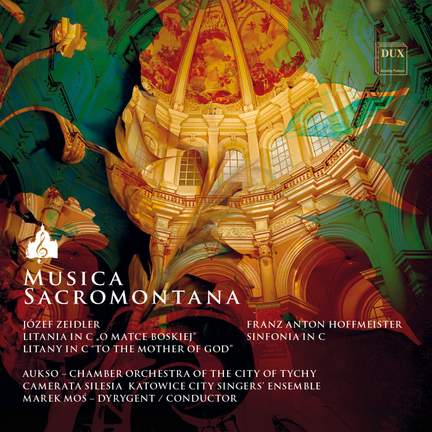
Musica Sacromontana
Aukso - Chamber Orchestra of the City of Tychy, Camerata Silesia Katowice City Singers' Ensemble, Marek Mos
Purchase product

About
Zeidler's Litany in C major to the Mother of God, one of 12 litanies in his output, seems to be representative of the composer's mature period. Such an assumption inevitably comes to mind when comparing it with Zeidler's two masses in D major, in copies dating from 1769, which are preserved at the Staatsbibliothek in Munich. These are Zeidler's earliest known works, most probably written for the Cistercian monastery in Obra, western Poland, before the composer's arrival in Gostyn. In them, the young composer clearly wished to demonstrate his knowledge of advanced musical language, as evidenced by the excessive ornamentation of vocal lines and the use of complicated counterpoint.
The Litany in C contains no features of this kind. What we find here is a simplicity typical of Classical aesthetics, which has all the hallmarks of the composer's conscious artistry. A sense of naturalness (inherited from Rococo art), structural clarity, symmetry, and the repetition of phrases enhances the impression of inner order. The work is also notable for a meticulously planned dramaturgy of its expanded cantata form. Zeidler is trying to diversify and enhance its inner drama, almost in spite of the character of the Litany of Loreto text, which is explicitly panegyrical in its adoration of the supernatural virtues of the Holy Virgin Mary. He gives prominence to the work's outer sections (Kyrie and Agnus Dei), which refer to the Holy Trinity, while dividing the long text of the litany addressing the Holy Virgin into four shorter fragments. This allows the composer to change the performance forces, key, tempo, and the type of motivic patterns, and, in the final account, the overall expressive character of the music.
Contents and tracklist
- Aukso Orchestra, Camerata Silesia
- Marek Moś
- Aukso Orchestra
- Marek Moś
