Special offer. Invisibles
Astrig Siranossian (cello), Nathanaël Gouin (piano)
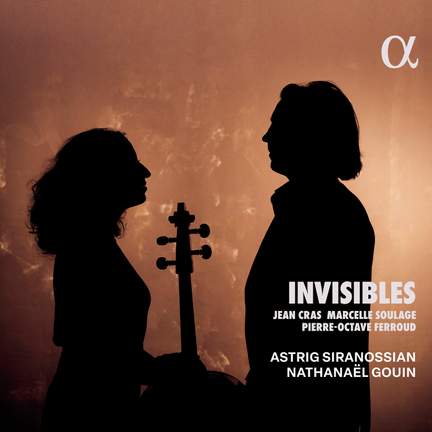
You know you’re in unfamiliar territory when a recording’s most familiar landmark is the 1901 Cello Sonata by Jean Cras (1879-1932). But you’re in good hands when you’re guided by Astrig Siranossian...
Special offer. Invisibles
Astrig Siranossian (cello), Nathanaël Gouin (piano)
Purchase product

You know you’re in unfamiliar territory when a recording’s most familiar landmark is the 1901 Cello Sonata by Jean Cras (1879-1932). But you’re in good hands when you’re guided by Astrig Siranossian...
About
Astrig Siranossian and Nathanael Gouin pluck from obscurity three rare works that time has rendered (temporarily) invisible. The first of these sonatas for cello and piano, recorded at the La Grange-Fleuret Music Library, was composed by Jean Cras in 1901, when he was a young naval officer aged twenty-two. It displays his precocious mastery of form and texture. Pierre-Octave Ferroud's Sonata, written in 1932, four years before this promising composer died in a car accident at the age of thirty-six, evokes a very different mood. Marcelle Soulage is certainly the least-known of the three. A pupil of Nadia Boulanger, teacher, radio producer and journalist in addition to her work as a composer, she was a founder member of the Groupe Instrumental Feminin in the 1950s. Her Sonata in F sharp minor, written in 1919 when she was twenty-five, reveals inventive qualities that were already very apparent.
Contents and tracklist
Spotlight on this release
-
An error occurred.
Try watching this video on www.youtube.com, or enable JavaScript if it is disabled in your browser.
Awards and reviews
 December 2024
You know you’re in unfamiliar territory when a recording’s most familiar landmark is the 1901 Cello Sonata by Jean Cras (1879-1932). But you’re in good hands when you’re guided by Astrig Siranossian and Nathanaël Gouin – for having resurrected three ‘invisible’ sonatas (works largely forgotten), they make a strong case for their choices.