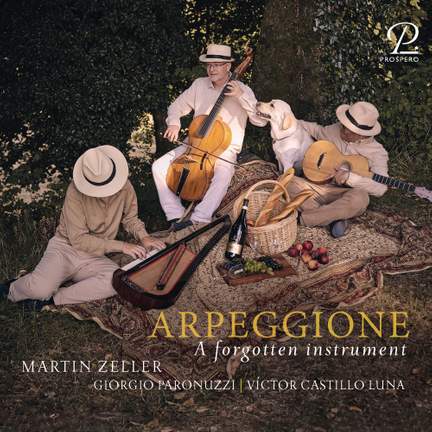
Arpeggione - A Forgotten Instrument
Martin Zeller, Giorgio Paronuzzi, Víctor Castillo Luna, Víctor Luna Castillo
There’s a lot to enjoy here. The Arpeggione Sonata itself has a lovely easy tempo, subtle metrical fluidity and a whimsical, shapely lilt. Zeller’s neatly sprightly account is also more boldly...
Arpeggione - A Forgotten Instrument
Martin Zeller, Giorgio Paronuzzi, Víctor Castillo Luna, Víctor Luna Castillo
Purchase product

There’s a lot to enjoy here. The Arpeggione Sonata itself has a lovely easy tempo, subtle metrical fluidity and a whimsical, shapely lilt. Zeller’s neatly sprightly account is also more boldly...
About
Franz Schubert's Arpeggione Sonata is so famous that many people know the name of the instrument thanks to this work; but very few people are likely to have ever heard it.
Even for the first printing of the sonata in 1871, alternative parts for violin or cello were produced because the arpeggione had fallen into oblivion.
To mark the 200th birthday of the instrument invented in 1823, Martin Zeller, Giorgio Paronuzzi and Victor Castillo Luna have selected works by Schubert, Romberg and Spohr in which the arpeggione plays a leading role.
Contents and tracklist
- Martin Zeller, Giorgio Paronuzzi
- Martin Zeller, Víctor Castillo Luna
- Martin Zeller, Víctor Castillo Luna
- Martin Zeller, Giorgio Paronuzzi
- Martin Zeller, Giorgio Paronuzzi
- Martin Zeller, Giorgio Paronuzzi
- Martin Zeller, Giorgio Paronuzzi, Víctor Luna Castillo
Spotlight on this release
-
An error occurred.
Try watching this video on www.youtube.com, or enable JavaScript if it is disabled in your browser.
Awards and reviews
 October 2024
There’s a lot to enjoy here. The Arpeggione Sonata itself has a lovely easy tempo, subtle metrical fluidity and a whimsical, shapely lilt. Zeller’s neatly sprightly account is also more boldly early-Romantic than day-job cellists often dare when handling this strange instrument.
Pizzicato
Martin Zeller, Giorgio Paronuzzi and Victor Castillo Luna illustrate how this mixture works perfectly once again at the end of their programme - in the serenade from the Swan Song. The arpeggione sings passionately, the guitar supports the folk song character and the fortepiano adds an extra touch of authenticity to the performance.