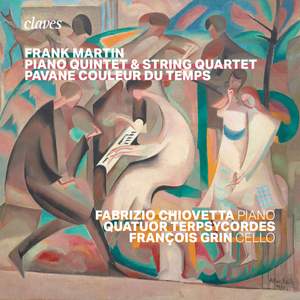
Chamber music meanders throughout Frank Martin’s career in a multitude of different ensembles and titles, ranging from the classical to the more unexpected, such as the Rhapsodie for string quintet with double bass, the Sonata da chiesa for viola d’amore and organ, the Ballade for trombone and piano or the Petite fanfare for brass sextet. Within this abundance, the composer approached only sparingly the most historically established genres. His only string quartet is a late work, his last chamber music piece. On the contrary, the Quintet for piano and strings and the Pavane couleur du temps are among his earliest contributions in this field.
At the end of 1918, Martin married Odette Micheli, and the young couple moved to Zurich. The Quintet for piano and strings was composed in this city a few months later. The work belongs to a period during which the composer’s style gradually freed itself from post-romanticism and became more personal. Martin’s recent meeting with Ernest Ansermet coincided with a marked interest in the music of Claude Debussy and Maurice Ravel, of whom the conductor was a strong advocate. The Quintet bears witness to this influence but goes far beyond it. An unusual conception of this musical genre can already be heard in the very first bars. Over a sorrowful accompaniment by the violins and viola, the cello introduces a plaintive, passionate melody. It is not until the sixteenth bar that the piano makes a timid appearance. With only a few exceptions, the piano remains in the background throughout the piece, confining itself to providing colour or rhythmic support. This is a far cry from the piano quintet tradition, which, from Johannes Brahms to Gabriel Fauré and César Franck, has placed the keyboard on an equal footing with the strings. It is in the minuet that the spirit of Ravel is most explicitly found: the dance is highly stylised here, and both the rhythmic momentum and certain pizzicato and arpeggiated chord effects recall the world of the French composer.