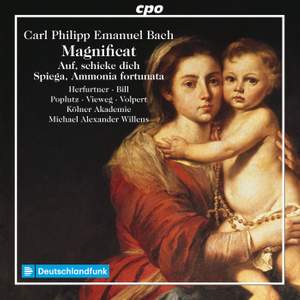


C.P.E. Bach: Magnificat, Auf, schicke dich, recht feierlich & Ammonia fortunata
Kölner Akademie, Kölner Akademie Choir, Michael Alexander Willens
Willens and his Cologne forces do it proud, more closely recorded than a highly regarded rival (an Editor’s Choice nearly a decade ago) and with a prominent harpsichord continuo that clatters... — More…
CD
$15.75Downloads
What are FLAC and MP3?Contents
Michael Alexander Willens: Magnificat, Wq.215
Work length42:22
$10.00
$13.00
$17.50
- Kölner Akademie and Michael Alexander Willens featuring Hanna Herfurtner, Elvira Bill, Georg Poplutz and Matthias Vieweg, Kölner Akademie and Michael Alexander Willens featuring Hanna Herfurtner, Elvira Bill, Georg Poplutz, Matthias Vieweg and Kölner Akademie Choir, Hanna Herfurtner, Elvira Bill, Georg Poplutz, Matthias Vieweg
- Kölner Akademie, Kölner Akademie Choir
- Michael Alexander Willens
01 Tutti 'Magnificat anima mea Dominum'
Track length3:08
$1.00
$1.30
$1.75
02 Aria 'Quia respexit humilitatem ancillae suae'
Track length4:55
$1.00
$1.30
$1.75
03 Aria 'Quia fecit mihi magna'
Track length4:05
$1.00
$1.30
$1.75
Michael Alexander Willens: Auf, schicke dich, Wq. 249
Work length18:48
$9.00
$11.70
$15.75
- Kölner Akademie and Michael Alexander Willens featuring Hanna Herfurtner, Elvira Bill, Georg Poplutz and Markus Volpert, Kölner Akademie and Michael Alexander Willens featuring Hanna Herfurtner, Elvira Bill, Georg Poplutz, Markus Volpert and Kölner Akademie Choir, Hanna Herfurtner, Elvira Bill, Georg Poplutz, Markus Volpert
- Kölner Akademie, Kölner Akademie Choir
- Michael Alexander Willens
11 Choral 'Auf, schicke dich'
Track length0:41
$1.00
$1.30
$1.75
12 Arie 'Groß ist der Herr'
Track length3:29
$1.00
$1.30
$1.75
13 Recitativ 'Wohin mein Auge blickt'
Track length1:03
$1.00
$1.30
$1.75
Michael Alexander Willens: Spiega, Ammonia fortunata, Wq. 216
Work length7:38
$2.00
$2.60
$3.50
- Kölner Akademie and Michael Alexander Willens featuring Hanna Herfurtner, Elvira Bill, Georg Poplutz, Markus Volpert and Kölner Akademie Choir, Hanna Herfurtner, Elvira Bill, Georg Poplutz, Markus Volpert
- Kölner Akademie, Kölner Akademie Choir
- Michael Alexander Willens
20 Chorus 'Spiega, Ammonia fortunata'
Track length7:38
$2.00
$2.60
$3.50