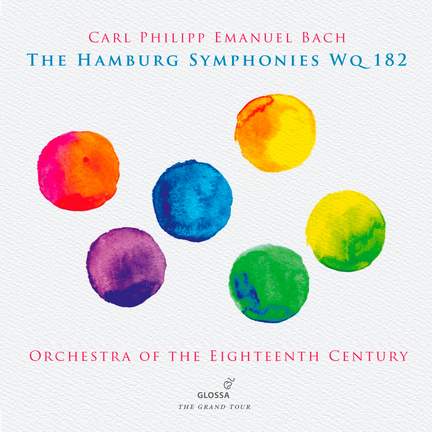
CPE Bach: The Hamburg Symphonies Wq 182
Orchestra of the 18th Century, Alexander Janiczek
Awards:
-
Gramophone Magazine, January 2024, Editor's Choice

-
BBC Music Magazine, February 2024, Orchestral Choice

Directing from the violin, Alexander Janiczek galvanises a robust and full-bodied string sound, further enhanced by a conspicuously warm and spacious recording. His is assailed by a subtle restlessness.
CPE Bach: The Hamburg Symphonies Wq 182
Orchestra of the 18th Century, Alexander Janiczek
Purchase product

Awards:
-
Gramophone Magazine, January 2024, Editor's Choice
-
BBC Music Magazine, February 2024, Orchestral Choice
Directing from the violin, Alexander Janiczek galvanises a robust and full-bodied string sound, further enhanced by a conspicuously warm and spacious recording. His is assailed by a subtle restlessness.
About
The Orchestra of the Eighteenth Century continues true to its original guiding spirit, with a new recording of the six Hamburg Symphonies, Wq 182 by Carl Philipp Emanuel Bach.
This second son of JS Bach, Carl Philipp has sometimes had a rough ride with posterity (and with some of his contemporaries too). Although overshadowed later by Haydn and Mozart - albeit admired by the pair - and overshadowed in his lifetime by Handel, he remains a crucial link between the Baroque and the Classical, particularly for the ultra-sensitive style, his Empfindsamkeit.
Thirty years spent writing hundreds of harpsichord works in the Berlin of Frederick II of Prussia before moving to Hamburg to write religious music at the Johanneum, his mind was awash with new and different ideas appreciated by Gottfried van Swieten. This baron commissioned these six symphonies, urging Carl Philipp to aim high in his compositional writing, and he responded by giving free rein to his musical ideas and his treatment of the instruments in these six three-movement works.
Scored for strings and continuo, these works from 1773 have very little in common with other pre-classical symphonies, including those by Carl Philipp's brother Johann Christian (or Italian opera overtures), as is remarked upon by Emilio Moreno in his booklet essay.
The Orchestra - here with Alexander Janiczek as leader - responds with evident pleasure to Bach's rich harmonies, bold dynamics and flowing melodies and with much appetite for his virtuosic instrumental writing.
Contents and tracklist
- Orchestra of the 18th Century
- Alexander Janiczek
- Orchestra of the 18th Century
- Alexander Janiczek
- Orchestra of the 18th Century
- Alexander Janiczek
- Orchestra of the 18th Century
- Alexander Janiczek
- Orchestra of the 18th Century
- Alexander Janiczek
- Orchestra of the 18th Century
- Alexander Janiczek
Awards and reviews
-
Gramophone MagazineJanuary 2024Editor's Choice
-
BBC Music MagazineFebruary 2024Orchestral Choice
 February 2024
Directing from the violin, Alexander Janiczek galvanises a robust and full-bodied string sound, further enhanced by a conspicuously warm and spacious recording. His is assailed by a subtle restlessness.
 January 2024
If any recording of this still-astonishing, unnerving music can give Pinnock a run for his money, it’s this new one.