Special offer. Samuel Ducommun: Musique de Chambre
Anne-Laure Pantillon, Theresa Wunderlin, Aline Glasson, Alba Luna Sanz, Marc Pantillon, Klara Flieder, Christophe Pantillon, Johannes Flieder
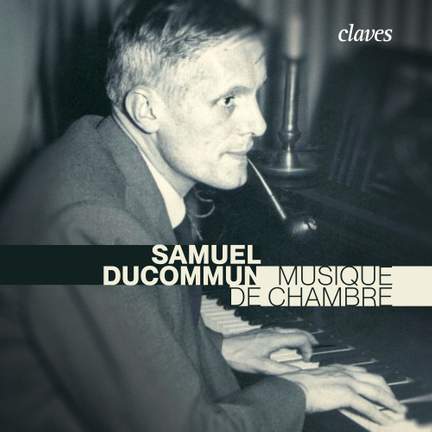
Special offer. Samuel Ducommun: Musique de Chambre
Anne-Laure Pantillon, Theresa Wunderlin, Aline Glasson, Alba Luna Sanz, Marc Pantillon, Klara Flieder, Christophe Pantillon, Johannes Flieder
Purchase product

About
Friendship and family
Both a singer as well as an inveterate music lover, the public prosecutor for the State of Neuchatel Pierre Aubert also happens to be the author of one of the rare portraits of Samuel Ducommun (with perhaps the monography published at Infolio in 2014 by the undersigned...). It begins with this compelling assertion about this man's relation to posterity: "Faulkner once said: It is my ambition to be, as a private individual, abolished and voided from history, leaving it markless, no refuse save the printed books (Joseph Leo Blotner, 1978, Selected letters of William Faulkner). Yet, a biography of more than a thousand pages was written about him. Samuel Ducommun appears to have been even more reserved than Faulkner. He never spoke about himself, didn't have any personal ambition, not even to disappear from history, and even the destiny of his work, before and after his death, didn't interest him". Towards the end of his life he will state: "For a composer, the very fact of having accomplished his work, solving problems, managing to progress, seems to me the ultimate reward. The joy of a public performance of one's creations is an added pleasure, but it isn't imperative." This form of extreme abnegation is Samuel Ducommun's own business. And it must be respected. However, it needn't prevent other people from paying close attention to his work: after all hadn't Ducommun spent a good part of his life drawing his pupils' attention (in his singing, organ tutoring and theory classes) to the innumerable treasures to be found in the history of music ? Perhaps, had he feared the disadvantage of comparisons... If such was the case, he was proved wrong. His inventory is made up of more than a hundred pieces of music of all types (with the exception of opera). It shows a steadfast vision, prompted just as much by his masters, as by his firm attachment to the Protestant cult. This powerful inner inspiration renders his art at once identifiable.
Opening doors
Is one in truth born with such creativity ? Samuel Ducommun will show his forceful resolve on the first day of summer in the ill-fated year of 1914, in Peseux, near Neuchatel. His father, an accountant at the Suchard Factory, had been bringing up his two children on his own, ever since 1923 when his wife died: he made sure that "willingly or not" (according to Pierre Aubert) his children would become accomplished musicians, while making sure his son acquired a "real profession" at the same time! The Swiss institution for future teachers (Ecole Normale) offers an ideal combination, allowing space for artistic studies: Samuel Ducommun will thus become a schoolmaster, and he will never complain about his profession. To teach is to pass on knowledge opening doors, enabling pupils to come into their own, not so different from composing really, apart from the fact that the teacher is doing this "live", on turf, so to speak. To teach is also creating bonds, sowing seeds of knowledge that might blossom years later: apart from his music still somewhat confidentially known, the testimonies of his charisma as a teacher are numerous, and without doubt prove to be the best consecration in regard to a man fully dedicated to his fellow being.
The organist
Samuel Ducommun is in good hands from the beginning. Enthralled with the organ at an early age - he sees Charles Faller's feet, very active on the church gallery in Le Locle, Charles Faller who later will become his teacher - he studies under the guidance of Louis Kelterborn, and later is tutored by Faller, all the way to his Master achieved in 1938. Samuel Ducommun then goes to Paris and benefits from Marcel Dupre's magnificent knowledge. He is taught theory by Charles Humbert and Paul Benner (whose masterpieces as well as those of Ducommun will soon be performed in concert halls). After Corcelles and Bienne, he settles down at the Neuchatel Collegiate Church in 1942, where he will officiate for 45 years. So, along with his predecessor Albert Quinche who had taken up his post in 1902, one could say they both almost cover the entire century! One of his greatest achievements during that time is the creation in 1943 of an association, a forerunner in fact of the still very active "Societe des Concerts de la Collegiale", which will manage to raise the money in order to acquire a brand new organ unveiled in 1952 by Marcel Dupre himself!
An apple a day
Meanwhile Samuel Ducommun is an accomplished soloist in all of Switzerland as well as in the bordering countries, as he disliked travelling... Special attention is paid to 20th century music (including Swiss composers). He teaches the organ, harmony, analysis, counterpoint and composition at Neuchatel Conservatory. And of course, he composes. His daughter Jacqueline, who died too soon in December 2021 after having championed his music all her life recalled: "He carried at all times a small notebook in wh
Contents and tracklist
- Anne-Laure Pantillon, Theresa Wunderlin, Aline Glasson, Alba Luna Sanz
- Marc Pantillon, Klara Flieder
- Marc Pantillon, Christophe Pantillon
- Marc Pantillon, Anne-Laure Pantillon, Johannes Flieder, Christophe Pantillon, Klara Flieder