Leopold Hofmann: Six Divertimenti Op.1
Musica Elegentia, Matteo Cicchitti
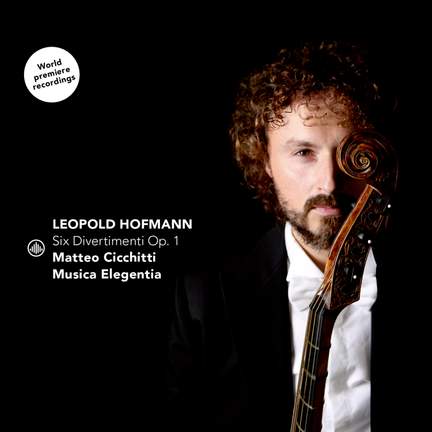
Leopold Hofmann: Six Divertimenti Op.1
Musica Elegentia, Matteo Cicchitti
Purchase product

About
The world premiere recording of a sophisticated and elegant collection of gallant string trios by Leopold Hofmann, performed by Musica Elegentia and Matteo Cicchitti.
In 1769, Leopold Hofmann (Wien, 1738 - Wien, 1793) succeeded Georg Christoph Wagenseil (whose pupil he had been) as harpsichord and organ teacher to the imperial family and in 1772 he became Organist and Chapel Master at St. Stephan's Cathedral. In 1783, he retired from the music profession. As one might reasonably expect from a pupil of Wagenseil, Leopold was an excellent harpsichordist and organist; nevertheless, he concentrated on other genres including, in particular, string music. His chamber music production for strings is particularly noteworthy.
The Six Divertimenti, Op.1 were published in 1775 by Johann Julius Hummel whose publishing house had offices in Amsterdam and Berlin. Op. 1 consists of 6 trios for strings: they belong to the genre of the divertimento. As Heinrich Christoph Koch illustrated in the Musikalisches Lexikon (1802), the 'Divertimento' was a kind of polite dialogue between instruments, not polyphonic and not hinged on any complicated process of motivic elaboration, but rather conceived for an amiable and pleasant listening. Even the divertimento, therefore, became part of the formal testimonials of the galant style, with which it shared a taste for pleasantness, an inclination towards much more transparent and airy musical textures than the preceding baroque period and, from a sociological point of view, an openness towards the world of amateurs, i.e. those aristocratic or upper-class performers. This is the galant context in which Leopold Hofmann's compositions fitted perfectly.
As far as the instrumentation is concerned, Opus 1 attests to two different types of compositions: the first three are for viola, cello and violone, and the remaining for violin, cello and violone. Variable arrangements are also recorded with regard to the number and type of movements into which each divertimento is subdivided: ranging from Trio No. 5 consisting of only two movements to No. 1, which, on the other hand, has five. On the musical texture front, there is a partially retrospective treatment that, in some respects, seems to echo that of the Baroque triosonata. The real leading role is, in fact, handed over to the two high instruments.
Contents and tracklist
- Matteo Cicchitti
- Musica Elegentia
- Matteo Cicchitti
- Musica Elegentia
- Matteo Cicchitti
- Musica Elegentia
- Matteo Cicchitti
- Musica Elegentia
- Matteo Cicchitti
- Musica Elegentia
- Matteo Cicchitti
- Musica Elegentia