Special offer. Wilms: Piano Quartets & Piano Trio
G.A.P. Ensemble
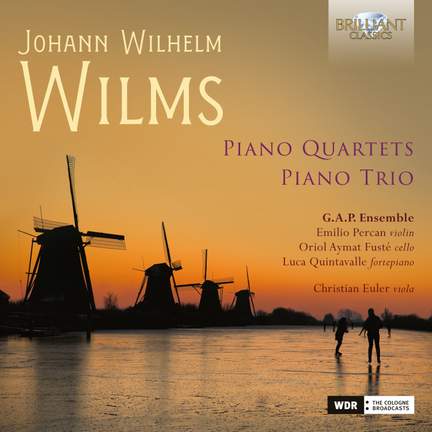
Special offer. Wilms: Piano Quartets & Piano Trio
G.A.P. Ensemble
Purchase product

About
In 1807, the Allgemeine musikalische Zeitung described the composer Johann Wilhelm Wilms (1772-1847) as “one of the most ingenious, spirited, and best educated artists” of his generation. Undoubtedly, this contemporary of Beethoven was among the most important composers in the Netherlands during his lifetime. Born in 1772 near Solingen, Germany, Wilms went to Amsterdam in 1791 and made a name for himself as an outstanding improviser on the piano and as a flautist in various orchestras in the city. He increased his fame by performing his own and others' piano concertos (especially with the Felix Meritis Orchestra) and as a teacher of piano and composition. From 1793, thanks to the first publications of his works, he became an appreciated composer beyond the borders of his adopted country, Holland, and his music was also performed in Leipzig, Breslau, and Prague.
Of his two piano quartets the Op.22 is a chamber work in four movements in which the piano plays the role of 'primus inter pares', while Op.30, in three movements, is more appropriately a piano concerto with string trio accompaniment. While still fully adhering to the spirit of the 18th century, especially from a formal point of view, these are works that, in terms of intensified virtuosity and harmonic freedom, can be compared to the compositions and style of composers such as Franz Danzi, Anton Eberl, Jan Ladislav Dussek and Carl Maria von Weber.
The period instrument G.A.P. Ensemble consists of Emilio Percan, violin, Oriol Aymat Fusté, violoncello, and Luca Quintavalle, harpsichord/fortepiano. They worked with artists like Viktoria Mullova, Daniel Hope, Cecilia Bartoli, Christophe Rousset, Fabio Biondi, Julia Lezhneva, Raffaella Milanesi and Hille Perl and performed at some of the most renowned concert halls in the world, for example Berliner Philharmonie, Teatro Colón Buenos Aires, Tokyo Opera City Center Hall and Palau de la Música Barcelona.