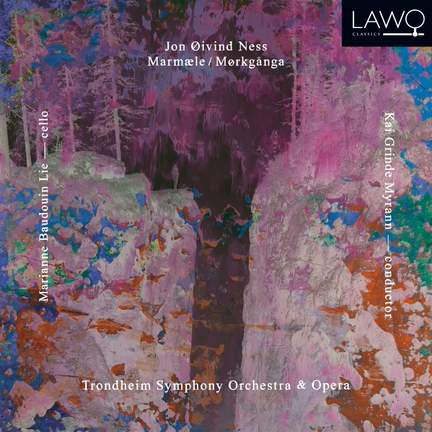
Special offer. Jon Oivind Ness: Marmaele/Morkganga
Marianne Baudouin Lie, Trondheim Symphony Orchestra & Opera, Trondheim Sympony Orchestra & Opera, Kai Grinde Myrann
Awards:
-
Opus Klassik Awards, 2023, Nominated - Conductor of the Year

-
International Classical Music Awards, 2024, Nominated - Contemporary Music

Special offer. Jon Oivind Ness: Marmaele/Morkganga
Marianne Baudouin Lie, Trondheim Symphony Orchestra & Opera, Trondheim Sympony Orchestra & Opera, Kai Grinde Myrann
Purchase product

Awards:
-
Opus Klassik Awards, 2023, Nominated - Conductor of the Year
-
International Classical Music Awards, 2024, Nominated - Contemporary Music
About
Jon Oivind Ness is a linguist on a forest walkabout, a collector of strange words and strange places, a romantic ironist who is deeply sincere in all his ambiguity. His music may have become more serious than it used to be, but that is also because his tonal language has become more consolidated and his style more patient. I still don't think this gravitas would have been possible without his long relationship with, and sharp ear for the absurd, the silly and the kooky. It is actually quite possible to have fun, even for a microtonal composer from Inderoy.
Morkganga is a narrow gorge somewhere in the Ringerike area in eastern Norway. I have never set foot there, but it is exactly the kind of place that Jon Oivind finds and cherishes when on his interminable hikes through the eastern Norwegian scrub, forest and fields. The moment you give a work a title which is more specific than, say, "symphony" or "sonata", then the listener has inevitably been influence with some sort of intent for the piece. It is no coincidence that the title Morkganga is taken from the forests around Oslo.
The marmaele comes from Norse folklore and is a half-man and half-fish sea creature. Legend has it, that if you catch the marmaele on a hook you have to ensure it's kept warm and released back into the sea before the day is up. Though we should generally be wary of listening to music too programmatically and literally, it is difficult to not hear the cello as the marmaele, a little creature giggling at a joke only he can understand. The work is not your archetypal instrumental concerto in the sense that the individual stands in contrast to the collective. Rather, it works as a symphonic poem with an extensive solo part in the tradition of, say, Berlioz' Harold en Italie, where the soloist comments on and illuminates the work's structure and content. The marmaele plays the role of a guide to its element.
Contents and tracklist
Awards and reviews
-
Opus Klassik Awards2023Nominated - Conductor of the Year
-
International Classical Music Awards2024Nominated - Contemporary Music