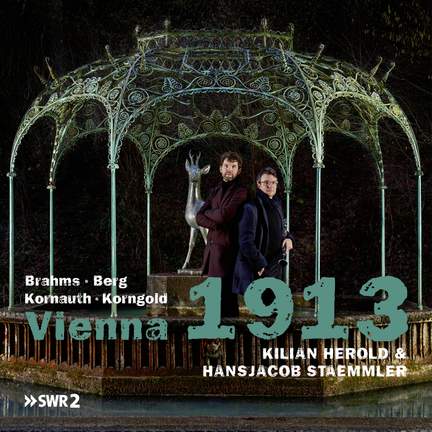
Vienna 1913: Brahms, Berg, Kornauth, Korngold
Kilian Herold (clarinet), Hansjacob Staemmler (piano)
Even if the packaging did not point up the theme of 1913 in Vienna, this delectable recording would still be a feast of amazing music, beautifully played...Kornauth may be new to many listeners...
Vienna 1913: Brahms, Berg, Kornauth, Korngold
Kilian Herold (clarinet), Hansjacob Staemmler (piano)
Purchase product

Even if the packaging did not point up the theme of 1913 in Vienna, this delectable recording would still be a feast of amazing music, beautifully played...Kornauth may be new to many listeners...
About
The year 1913 could be regarded as a kind of focus year of the most interesting upheaval period in the early years of the 20th Century. Egon Kornauth's Clarint Sonata is a discovery of a masterpieces, and appears on record first time ever a world premiere recording. Together with Berg's and Korngold's pieces it was published in 1913. For all of them Brahms was a kind of foster father. Kilian Herold and Hansjacoob Staemmler are both highly regarded soloists and chamber musicians, both are holding a professorship at the Music academy in Freiburg / Germany.
The years 1900-1914 were perhaps the most thrilling period in European music history: the cradle of what we now call musical Modernism. This was the time when the great "avant-garde schools" took shape: in Paris, Berlin, Saint Petersburg, and particularly in Vienna. Music branched out into a multitude of aesthetics, styles, and genres, as we can see in in the variety of terms that attempt to describe art in that period: Impressionism, Expressionism, Art Nouveau, Neo-Classicism, Foklorism, Late Romanticism, Symbolism, and others.
Our programme selection for this CD focuses on two works written in Vienna in 1913 the "summer of the century", as author Florian Illies calls a pivotal year that put an end to the long 19th century and introduced the sombre 20th century. The two works are Alban Berg's Four Pieces for Clarinet and Piano op. 5 and Egon Kornauth's Sonata for Clarinet and Piano. 1913 was the year of several "scandalous" premieres: Schoenberg's Gurrelieder, Berg's Altenberglieder, Stravinsky's Rite of Spring, and others that were less scandalous: Debussy's Images pour Orchestre, Max Reger's Isle of the Dead, Sibelius's Luonnotar, de Falla's La vida breve, and Richard Strauss's Festliches Praludium. (Excerpt from the liner notes by Ludwig Holtmeier)
Contents and tracklist
- Kilian Herold (clarinet), Hansjacob Staemmler (piano)
- Recorded: 2021-10
- Recording Venue: Hans-Rosbaud-Studio, Baden-Baden
- Kilian Herold (clarinet), Hansjacob Staemmler (piano)
- Recorded: 2021-10
- Recording Venue: Hans-Rosbaud-Studio, Baden-Baden
- Kilian Herold (clarinet), Hansjacob Staemmler (piano)
- Recorded: 2021-10
- Recording Venue: Hans-Rosbaud-Studio, Baden-Baden
- Kilian Herold (clarinet), Hansjacob Staemmler (piano)
- Recorded: 2021-10
- Recording Venue: Hans-Rosbaud-Studio, Baden-Baden
- Kilian Herold (clarinet), Hansjacob Staemmler (piano)
- Recorded: 2021-10
- Recording Venue: Hans-Rosbaud-Studio, Baden-Baden
Awards and reviews
 January 2023
Even if the packaging did not point up the theme of 1913 in Vienna, this delectable recording would still be a feast of amazing music, beautifully played...Kornauth may be new to many listeners and he proves to be well worth a whirl.
 May/June 202
Herold’s performances on this recording are superb. The featured repertoire demands a vast array of technical and musical strengths, all of which Herold possesses in abundance. His beautiful singing tone, facility in rapid passagework, security throughout the registers, and impressive breath control testify to the presence of a master technician.