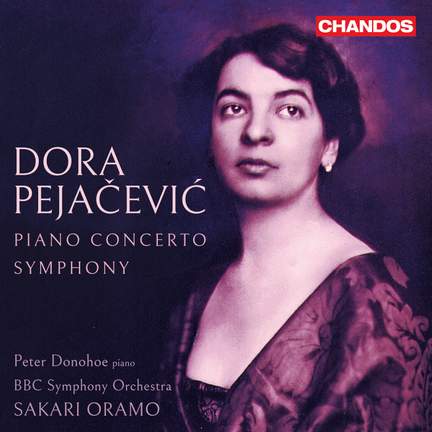
Special offer. Dora Pejačević: Piano Concerto & Symphony
Peter Donohoe (piano), BBC Symphony Orchestra, Sakari Oramo
Awards:
-
Presto Editor's Choice, April 2022

-
International Classical Music Awards, 2023, Nominated - Assorted Programs

[The Piano Concerto] boasts attractive melodies, warmly lush orchestration and technically demanding piano writing. Peter Donohoe revels in its manifold opportunities for virtuosic display,...
Special offer. Dora Pejačević: Piano Concerto & Symphony
Peter Donohoe (piano), BBC Symphony Orchestra, Sakari Oramo
Purchase product

Awards:
-
Presto Editor's Choice, April 2022
-
International Classical Music Awards, 2023, Nominated - Assorted Programs
[The Piano Concerto] boasts attractive melodies, warmly lush orchestration and technically demanding piano writing. Peter Donohoe revels in its manifold opportunities for virtuosic display,...
About
Countess Mária Theodora (Dora) Paulina Pejačević was born in September 1885 in Budapest. Young Dora grew up with all the advantages of an aristocrat: a fairy-tale life of opulent palaces set in idyllic landscapes; privilege, comfort, leisure, and wealth. From an early age she defied convention and walked her own path, one that eventually led her to ‘despise’ the aristocracy. Her father, Count Teodor Pejačević, a lawyer, held several high posts, including that of Civil Governor of Croatia, Slavonia, and Dalmatia (1903 – 07). Her mother, Lilla Vay de Vaya, an ‘exceptionally beautiful’ Hungarian countess, was a gifted pianist and singer, and a fine amateur artist. Her parents arranged private lessons with teachers at the Music School of the Croatian Music Institute, at Zagreb, which lead to further instruction in Dresden and Munich. Dissatisfied with the ‘limits’ of her formal studies, Pejačević pursued her own intensive course of self-instruction in composition. Having taken her music education into her own hands, she set off to enrich and broaden her intellectual horizons, travelling to cultural centres in Germany, Austria, Czechoslovakia, and Hungary. During these travels, she came to know the leading artists, poets, and intellectuals of the day. The Piano Concerto was her first orchestral composition, and the first piano concerto by any Croatian composer. She composed the Symphony in F sharp minor during the first world war, whilst also working as a volunteer nurse. For its first complete performance, in 1920, she revised the work, which is here recorded in this final version.
Contents and tracklist
Awards and reviews
-
Presto Editor's ChoiceApril 2022
-
International Classical Music Awards2023Nominated - Assorted Programs
 July 2022
[The Piano Concerto] boasts attractive melodies, warmly lush orchestration and technically demanding piano writing. Peter Donohoe revels in its manifold opportunities for virtuosic display, but also brings poetry and requisite tenderness to the beautifully lyrical writing in the slow movement. The Symphony is even more impressive.
 Sep/Oct 2022
[Piano Concerto] a genuinely appealing work of art, beautifully balanced structurally, thematically self-referential throughout, orchestrated for pretty turns of phrase with chimes, clever, and delivered here in a limpidly beautiful interpretation by Peter Donohoe and Sakari Oramo in lovely sound. There is not an ugly moment anywhere.
 April 2022
Pejačević's 1913 Piano Concerto is a big, bold, exhilarating affair which seems to look backward to Brahms and forwards to Rachmaninov and even early film-scores in some of its sweeping, expansive themes. Donohoe and Oramo do it full justice, and the Symphony in F sharp minor is equally worth hearing, with especially striking orchestration in the Scherzo and an Appassionato finale which carries all before it.
 29th December 2022
Rachmaninov was the obvious model in both works, but there’s Franck and Dvořák in the mix for the symphony too, but there’s enough originality in both works to make one wonder what direction Pejačeviċ’s music might have taken had she not died at the age of 37 in 1923.