

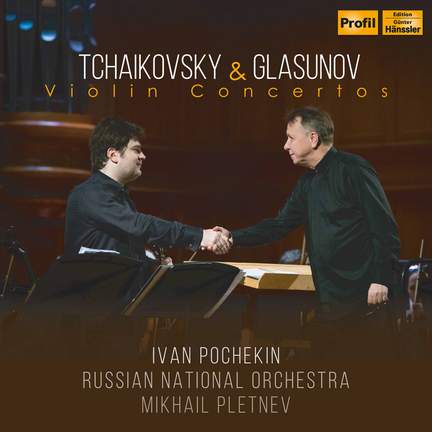
Tchaikovsky & Glazunov: Violin Concertos
Ivan Pochekin (violin), Russian National Orchestra, Mikhail Pletnev
Pochekin takes the Tchaikovsky Concerto at a very stately pace in a performance that’s more deliberate than exciting, though every note is as clear as a bell. His tone is particularly dark and...
Tchaikovsky & Glazunov: Violin Concertos
Ivan Pochekin (violin), Russian National Orchestra, Mikhail Pletnev
Purchase product

Pochekin takes the Tchaikovsky Concerto at a very stately pace in a performance that’s more deliberate than exciting, though every note is as clear as a bell. His tone is particularly dark and...
About
"This recording features the works of Russian composers who were outstanding personalities in the musical life of their country during their lifetime: The Violin Concerto in D major, op. 35, by Tchaikovsky and the Violin Concerto in A minor, op. 82, by Glazunov. Each of the two composers wrote only one concerto for violin and orchestra respectively, as did Beethoven or Brahms as well. The two concertos by Tchaikovsky and by Glazunov each quickly gained admirers in the West. The image of Tchaikovsky is well-known, who closely emulated Western European music, especialIy music originating in Italy, France and Germany. GIazunov, who had no conservatory training, acquired his skilIs as a composer with Rimsky-Korsakov. He was one of the members of the 'Mighty Handful' of five composers who banded together in Saint Petersburg in 1862 and calIed themselves novators, or innovators. They championed and strongly supported a national style of Russian classical music. There were therefore contrasts in style at the time. Yet Tchaikovsky, who was accused of 'Western leanings', was also an adherent of other contemporary Russian composers and his stance towards the novators was generaIIy positive, though differentiated. And GIazunov, the pupiI of Rimsky-Korsakov? The attitude he upheld was based on the maxim: 'I am possessed by music.' To use the slightly overstated words of VIadimir Fedorov: 'GIazunov can be seen as a type of musician who thinks only in musical terms, 'feels' through music and knows of no other interests than t his music ... to him in music there is nothing else but themes, rhythms, development, form, plasticity of the musical material and tonal colour of the orchestra. He thus focused almost exclusively on instru mental music, which thanks to its brilliance ensured him a special position among Russian composers of his day.'"
Contents and tracklist
- Ivan Pochekin (violin)
- Russian National Orchestra
- Mikhail Pletnev
- Ivan Pochekin (violin)
- Russian National Orchestra
- Mikhail Pletnev
Awards and reviews
 April 2022
Pochekin takes the Tchaikovsky Concerto at a very stately pace in a performance that’s more deliberate than exciting, though every note is as clear as a bell. His tone is particularly dark and rich in the lower register, and lends itself well to the Glazunov concerto’s melodrama
