Hanns Eisler: Deutsche Sinfonie, Op.50
ORF Vienna Radio Symphony Orchestra, Wiener Jeunesse Chor, Günther Theuring
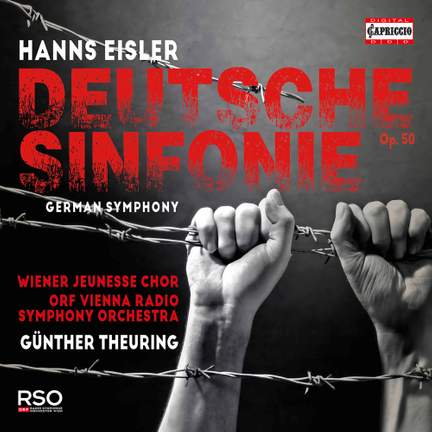
Given that Eisler’s choral work was spurred by the spread of Nazism it is, unsurprisingly, relentlessly dark and dramatic. The performance here crackles with atmosphere.
Hanns Eisler: Deutsche Sinfonie, Op.50
ORF Vienna Radio Symphony Orchestra, Wiener Jeunesse Chor, Günther Theuring
Purchase product

Given that Eisler’s choral work was spurred by the spread of Nazism it is, unsurprisingly, relentlessly dark and dramatic. The performance here crackles with atmosphere.
About
Of particular importance to Eisler was the principle of synthesis, merging a variety of musical aesthetics into an autonomous whole, while also wanting to ‘change the world’ with his music. The October Revolution of 1917 and the assumption of power by the Bolsheviks in Russia had shaped the young composer for the rest of his life. In the 1930s, during his years of exile, there was no topic that preoccupied him more than the sustained protest against National Socialism. Eisler wanted to make a musical stance against Fascism with his Opus 50; he wanted to show – together with his friend and librettist Bertolt Brecht – that there was not just a Nazi Germany, but another, better Germany. The German Symphony is arguably Eisler’s most important work, unique in its ingenious combination of symphony, cantata and oratorio.
Contents and tracklist
- Hanna Fahlbusch-Wald, Michael Ebbecke, Jaroslav Štajnc, Gottfried Neuner, Christian Schramm, Ursula Targler
- Wiener Jeunesse-Chor, Vienna Radio Symphony Orchestra
- Günther Theuring
Awards and reviews
 April 2021
Given that Eisler’s choral work was spurred by the spread of Nazism it is, unsurprisingly, relentlessly dark and dramatic. The performance here crackles with atmosphere.