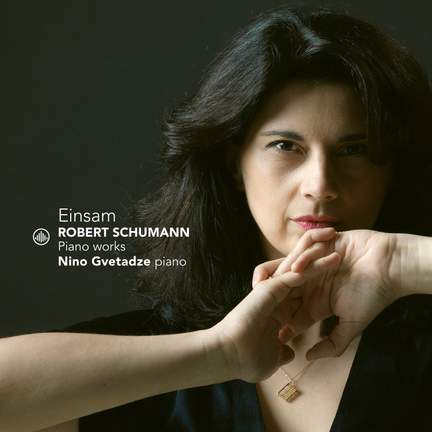
Einsam
Nino Gvetadze (piano)
This is, quite simply, gorgeous. Nino Gvetazde plays Schumann’s much-loved Arabeske, Kinderszenen and Kreisleriana, as though they flow spontaneously from her. Time is elastic, liberated from...
Einsam
Nino Gvetadze (piano)
Purchase product

This is, quite simply, gorgeous. Nino Gvetazde plays Schumann’s much-loved Arabeske, Kinderszenen and Kreisleriana, as though they flow spontaneously from her. Time is elastic, liberated from...
About
Nino Gvetadze has chosen to focus on the works of Robert Schumann for her third release on Challenge Classics. Written in the period 1838-9, the Kinderszenen, Op.15, Kreisleriana, Op.16 and Arabeske, Op.18 are among the finest works in the composer's output.
During the late 1830s Schumann wrote numerous works for the piano, many of which met with considerable success. The Arabeske in C, Op. 18 dates from early 1839. In a letter of 15 August Schumann described the piece, which was dedicated to Frau Majorin Friederike Serre auf Maxen, as "delicate for ladies", and it is true that it has a gently lyrical, dreamy quality. Yet there is more to the Arabeske than this modest description would suggest. Schumann had left Leipzig for Vienna in the autumn of 1838 after reaching an impasse in his relations with the Wiecks, and the keenness with which he felt the separation from Clara may be sensed in the Arabeske's mixture of wistfulness and determination.
Of the piano music written by Schumann in the 1830s, just two collections include movement titles: the Phantasiestcke, Op. 12, and the Kinderszenen, Op. 15 of 1838. Schumann sketched 30 "cute little things" in early 1838, from which he chose 13 to create the Kinderszenen. The vivid movement titles were attached to each of the Kinderszenen after the music had been written, rather than inspiring the musical content. Yet the tender romanticism of these pieces in Trumerei especially suggests that Clara was never far from Schumann's thoughts as he composed them.
Although Clara was a powerful source of inspiration for Robert, he was also profoundly influenced by both musical and literary sources, which helped him to make sense of his rich inner world. E.T.A. Hoffmann enabled Schumann to explore the different facets of his nature through the character of Johannes Kreisler, who appeared in several volumes including Hoffmann's Fantasiestcke, one section of which is entitled 'Kreisleriana'. Schumann strongly identified with Kapellmeister Kreisler: both men were devoted to the music of J.S. Bach, and both veered between extremities of mood, from ecstasy to despair. This multifaceted nature is encapsulated in the eight movements of Kreisleriana, Op. 16. Kreisler's brusque mood-swings are represented through Schumann's contrasts between dazzling virtuosity and lyrical tenderness, often anchored by the tonal contrast between the key areas of G minor and B-flat major. Schumann's dual nature, previously communicated through Florestan and Eusebius, had found a new mouthpiece. In contrast with the first decade of his career, which was almost entirely given over to piano music, Schumann did not write a great deal of solo piano music in the 1840s, producing just a handful of fugues and pieces for children. At the end of 1848 he began the Waldszenen ('Forest Scenes'), a set of nine short piano pieces. 'Vogel als Prophet' is one of the more disturbing pieces in the set.
Contents and tracklist
Spotlight on this release
-
An error occurred.
Try watching this video on www.youtube.com, or enable JavaScript if it is disabled in your browser.
Awards and reviews
 Christmas 2020
This is, quite simply, gorgeous. Nino Gvetazde plays Schumann’s much-loved Arabeske, Kinderszenen and Kreisleriana, as though they flow spontaneously from her. Time is elastic, liberated from the tyranny of the pulse...I found this a wholly persuasive depiction of a mercurial Schumann, without an aggressive bone in his body.
 March/April 2021
Nino Gvetadze’s playing is not only technically solid, easily able to handle the treacherous difficulties found in this music—particularly those in the dauntingly virtuosic Kreisleriana—but musically satisfying. Her playing is always eloquent, even in the most bombastic passages. And magically she does not underplay this music in any way...This is one of the best Schumann albums I have come across in some time
 December 2020
Gvetadze’s focus is unerring and, if the expressive content of the music is always front and centre, she also has an uncanny ability to elucidate the overall structure with immense subtlety. If you don’t yet know her playing, great pleasures await.