

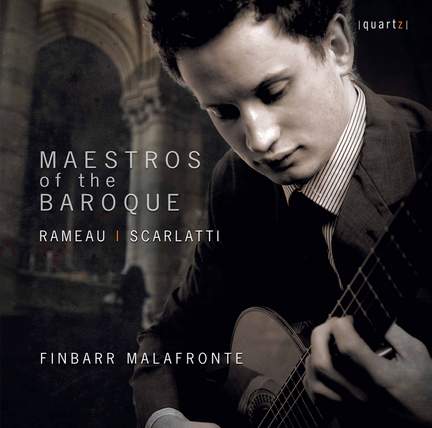
Maestros of the Baroque
Rameau - Scarlatti
Finbarr Malafronte (guitar)
That the arrangements are Malafronte’s own is commendable, and important to a consistent aesthetic. Listening, I just longed for more of the fluency, imagination and confidence of his erstwhile...
Maestros of the Baroque
Rameau - Scarlatti
Finbarr Malafronte (guitar)
Purchase product

That the arrangements are Malafronte’s own is commendable, and important to a consistent aesthetic. Listening, I just longed for more of the fluency, imagination and confidence of his erstwhile...
About
Music for the keyboard has dominated much of Western music history, with works for the harpsichord and its relatives forming a hugely significant portion of Baroque repertoire. Yet alongside the development of keyboard music, the guitar enjoyed a rich and varied evolution of its own. The Baroque guitar was particularly prominent in Spain, France and Italy, while romantic depictions of guitarists appeared in paintings by the likes of Dutch Baroque painter Johannes Vermeer. This programme brings together music by two great Baroque composers, one French, one Italian, whose harpsichord music lends itself superbly to these transcriptions for the guitar. Whereas the strings of the piano are struck, harpsichord strings are plucked with a plectrum-like device, creating a technical and audible relationship with the guitar. Jean-Philippe Rameau (1683-1764) was influenced by Couperin, who pioneered the style luthé or ‘lute style’ of harpsichord playing, and Domenico Scarlatti (1685-1757) lived in Spain for much of his life; he was greatly influenced by the Spanish guitar, and his use of repeated notes in his sonatas was intended to emulate the instrument.
Contents and tracklist
Awards and reviews
 August 2020
That the arrangements are Malafronte’s own is commendable, and important to a consistent aesthetic. Listening, I just longed for more of the fluency, imagination and confidence of his erstwhile teacher Barrueco.
