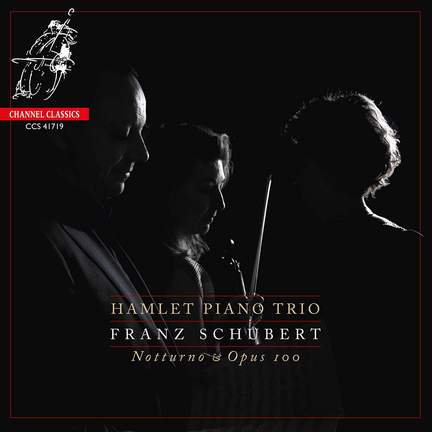
Schubert: Piano Trio No. 2 & Notturno
Hamlet Piano Trio
The piano trios aren’t often recorded on period instruments and it’s good to hear, just occasionally, the longer and more garrulous finale of the E flat, especially when played and engineered...
Schubert: Piano Trio No. 2 & Notturno
Hamlet Piano Trio
Purchase product
The piano trios aren’t often recorded on period instruments and it’s good to hear, just occasionally, the longer and more garrulous finale of the E flat, especially when played and engineered...
About
Paolo Giacometti (piano), Candida Thompson (violin), Xenia Jankovic (cello)
Some of Franz Schubert’s music – like the Trout Quintet or the Ave Maria – is heard time and again, while other pieces are hardly ever played. Even when the focus is on his chamber music, these extremes are evident. Of all fifteen string quartets, Death and the Maiden is played most, while others are true Cinderellas. The wonderful String Quintet in C major is played fairly frequently, and the two Piano Trios a little less. The present recording features beside opus 100, a great rarity, the Notturno in E flat major opus post.148 D897 for violin, cello and piano. Like much other chamber music, this piece was probably first played among
Schubert’s friends, or in his home, with the composer at the piano, his brother Ignaz or Ferdinand on the violin and father Schubert on the cello. Among the Schuber family the piece was known as the Adagio in E flat major. The publisher Diabelli fished it out of the composer’s estate in 1844 and issued it under the fantasy name Notturno. Today we know that it was written as second movement for the Piano Trio in E flat major opus 100, but then rejected by the composer himself. In its melodies and modulations Schubert’s pioneering style in the nineteenth century is clearly recognisable.
Contents and tracklist
- Hamlet Piano Trio
- Hamlet Piano Trio
Spotlight on this release
-
An error occurred.
Try watching this video on www.youtube.com, or enable JavaScript if it is disabled in your browser.
Awards and reviews
 January 2020
The piano trios aren’t often recorded on period instruments and it’s good to hear, just occasionally, the longer and more garrulous finale of the E flat, especially when played and engineered (Jared Sacks) as finely as it is here.
 1st March 2020
The excellent British, Serbian-Russian and Dutch-Italian Hamlet piano trio, on period instruments, give the richly inventive finale uncut — all 19 minutes of it — and it’s not a second too long. Occasionally, the 1826 piano’s bass chords sound uncomfortably gruff. Otherwise, all is pleasure.