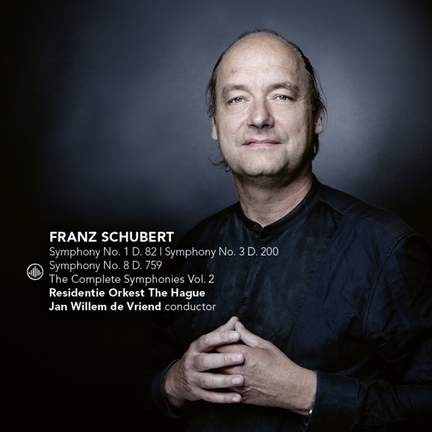
Schubert: Symphonies Nos. 1, 3 & 8 'Unfinished'
Complete Symphonies Vol. 2
Residentie Orkest The Hague & Jan Willem de Vriend
The string playing is so crisp and clear, even at faster than-average tempos, that, at least in the two early symphonies, the section sounds smaller than it actually is. Here, he does what Harnoncourt...
Schubert: Symphonies Nos. 1, 3 & 8 'Unfinished'
Complete Symphonies Vol. 2
Residentie Orkest The Hague & Jan Willem de Vriend
Purchase product

The string playing is so crisp and clear, even at faster than-average tempos, that, at least in the two early symphonies, the section sounds smaller than it actually is. Here, he does what Harnoncourt...
About
This is the second volume in de Vriend’s complete survey of Schubert’s symphonies and includes two youth symphonies (nos. 1 and 3) and the masterpiece that is the “Unfinished” Symphony No.8.
While offering little suggestion of the symphonic mastery he would attain less than a decade later, the First Symphony, influenced by Mozart’s last symphonies and completed in October 1813, is a remarkable achievement. Schubert composed his Third Symphony over a period of about two months, completing the work in July 1815. The Third Symphony is generally characterised by an increased rhythmic intensity, at times bordering on obsession. We may well think of Schubert primarily as a wonderful melodist, but driving, sometimes overpowering rhythm is just as strong a feature of many of his greatest works. The question of why Schubert left this B minor symphony unfinished has continued to exercise scholars. The most convincing explanation is that he simply found himself unable to continue on the same exalted level and resigned himself to leaving the symphony as it was - two movements of breath-taking quality and imagination.
Residentie Orkest The Hague has the reputation as one of the finest orchestras in Europe makes it an appropriate figurehead for The Hague as a cosmopolitan city of justice, peace, and culture. The orchestra performs concert series in the Zuiderstrandtheater in Scheveningen and in addition performs at venues such as Concertgebouw Amsterdam, TivoliVredenburg Utrecht and De Doelen in Rotterdam. The Residentie Orkest performs regularly at various other major concert halls abroad. Tours have brought the orchestra to New York, Boston, Chicago, London and Vienna amongst others and the orchestra also performed in countries like Japan, China, Germany, France and South America. There are also many prolific collaborations with a wide range of partners, including the Dutch National Theatre, Gemeentemuseum and the Dutch National Opera. Recent seasons have seen a much acclaimed production of Messiaen’s rarely performed opera Saint Francois d’Asisse, Poulenc’s Dialogues des Carmélites and Puccini’s La Boheme and Madama Butterfly.
Jan Willem de Vriend was appointed as principal conductor of Residentie Orkest The Hague in 2015 and as principal guest conductor of the Orquestra Simfonica de Barcelona i Nacional de Catalunya. From 2017 he has also been principal guest conductor of the Orchestre National de Lille.
Contents and tracklist
Awards and reviews
 January/February 2020
The string playing is so crisp and clear, even at faster than-average tempos, that, at least in the two early symphonies, the section sounds smaller than it actually is. Here, he does what Harnoncourt did in some of his recordings—observe the customs of the composer’s time, but with modern instruments. Although I was uncomfortable with the performances at the outset, I soon became accustomed to the sheer brio of his approach, which included striking variations in volume, decisive accents, and many lickety-split finales.