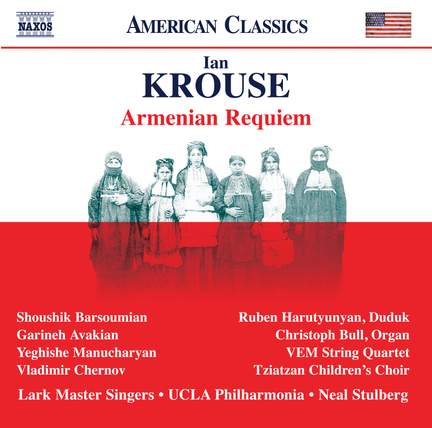
Ian Krouse: Armenian Requiem
Vladimir Chernov (baritone), Christoph Bull (organ), Shoushik Barsoumian (soprano), Garineh Avakian (mezzo-soprano), Yeghishe Manucharyan (tenor), Ruben Harutyunyan (duduk), VEM String Quartet, UCLA Philharmonia, Lark Master Singers, Tziatzan Children's Choir, Neal Stulberg
Krouse has – perhaps following Benjamin Britten in the War Requiem – not strictly followed the liturgical form of the traditional Armenian Mass, but has interspersed poetry, mostly by writers...
Ian Krouse: Armenian Requiem
Vladimir Chernov (baritone), Christoph Bull (organ), Shoushik Barsoumian (soprano), Garineh Avakian (mezzo-soprano), Yeghishe Manucharyan (tenor), Ruben Harutyunyan (duduk), VEM String Quartet, UCLA Philharmonia, Lark Master Singers, Tziatzan Children's Choir, Neal Stulberg
Purchase product

Krouse has – perhaps following Benjamin Britten in the War Requiem – not strictly followed the liturgical form of the traditional Armenian Mass, but has interspersed poetry, mostly by writers...
About
Composed to mark the centenary of the genocide of 1915, the Armenian Requiem is a large-scale sacred work structured around the liturgical chants encountered in requiem services appended to the traditional Armenian Mass. It is written in a form that, uniquely for the music of the country, is not based wholly on the model of the Latin Mass. Instead, taking the precedent of Britten’s War Requiem, Ian Krouse embeds poems as interludes, and his work – a poignant meditation on loss couched in a marriage of Western and Armenian forms – offers both conciliation and hope.
Contents and tracklist
- Vladimir Chernov (baritone), Christoph Bull (organ), Shoushik Barsoumian (soprano), Garineh Avakian (mezzo-soprano), Yeghishe Manucharyan (tenor), Ruben Harutyunyan (duduk), VEM String Quartet
- UCLA Philharmonia, Lark Master Singers, Tziatzan Children's Choir
- Neal Stulberg
- Recorded: 21-22 April 2015
- Recording Venue: Royce Hall, UCLA, Los Angeles, USA
Awards and reviews
 July 2019
Krouse has – perhaps following Benjamin Britten in the War Requiem – not strictly followed the liturgical form of the traditional Armenian Mass, but has interspersed poetry, mostly by writers little known in the west, and devices like the offstage trumpets of ‘Interlude II: Moon of the Armenian Tombs’. It’s an extraordinary piece, which manages, for all its scale and powerful orchestration, to seem quiet and inward to the point of intimacy. An astonishing achievement.