

Help
Skip to main content

US TARIFFS UPDATE | August 2025 | No impact expected on your Presto orders | Read full details

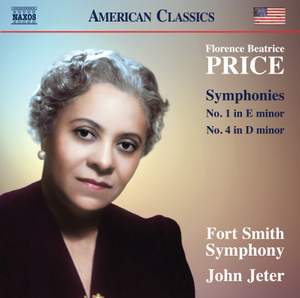
Florence Beatrice Price: Symphonies Nos. 1 & 4

Fort Smith Symphony, John Jeter

Florence Beatrice Price: Symphonies Nos. 1 & 4

Awards:

The E minor No. 1 starts on the same ground as Dvořák’s New World, but soon charts different terrain…all played with rhythmic élan, beguiling colour and evident joy. If not every corner is neat,...

Florence Beatrice Price: Symphonies Nos. 1 & 4

Fort Smith Symphony, John Jeter

Purchase product

CD

$14.25

In stock: usually despatched within 1 working day

Download

From$7.00

Download

Audio formats guide

96 kHz, 24 bit, FLAC/ALAC/WAV

$12.25

44.1 kHz, 16 bit, FLAC/ALAC/WAV

$9.00

320 kbps, MP3

$7.00

This release includes a digital booklet

Stream now Hi-RES 96 kHz, 24 bit

Awards:

The E minor No. 1 starts on the same ground as Dvořák’s New World, but soon charts different terrain…all played with rhythmic élan, beguiling colour and evident joy. If not every corner is neat,...

About

Florence Price was born in Little Rock, Arkansas and studied at the New England Conservatory, but it was in Chicago that her composing career accelerated. The concert in 1933 at which her Symphony No. 1 in E minor was premiered was the first time a major American orchestra had performed a piece written by an African American woman. Influenced by Dvorák and Coleridge-Taylor, she drew on the wellspring of Negro spirituals and vernacular dances, full of lyricism and syncopation. The Symphony No. 4 in D minor demonstrates her tight ensemble writing, her distinct sense of orchestral color, her Ellingtonian ‘jungle style’ language and her penchant for the ‘juba’ dance.

Contents and tracklist

I. Allegro ma non troppo
Track length16:40
II. Largo, maestoso
Track length12:16
III. Juba Dance
Track length3:40
IV. Finale
Track length4:49
I. Tempo moderato
Track length15:13
II. Andante cantabile
Track length5:40
III. Juba Dance
Track length5:17
IV. Scherzo
Track length5:21

Awards and reviews

April 2019

The E minor No. 1 starts on the same ground as Dvořák’s New World, but soon charts different terrain…all played with rhythmic élan, beguiling colour and evident joy. If not every corner is neat, this is still the recording of the First Symphony to own. And it’s paired with the first recording of the Fourth Symphony…This is a rich score that winningly blends European and African American influences.

April 2019

Her handling of the orchestra is idiomatic and strikingly original, with solos generously allocated throughout the ensemble. Each symphony describes a grand emotional trajectory, over the course of four movements, from deep seriousness to redemptive joy. The introduction or, more appropriately, restoration of Price’s unique voice is unquestionably an enrichment of the American symphonic canon.

March 2019

The Fort Smith Symphony deliver riveting performances of these two symphonic works, under the direction of their charismatic conductor John Jeter. This compelling music could have no better advocates.

January 2019

There's fun to be had in listening out for echoes of Dvořák in the First Symphony in particular (the brass chorale which opens the Largo sounds like the sunnier first-cousin of its counterpart in the New World), but Price’s quirky orchestration and innovative use of dance-rhythms are all her own – her writing for percussion is especially striking, and the juba-inspired scherzos are a delight.

The New York Times 12th December 2019

The brio of the best Americana is present throughout [the Fourth], particularly in its rousing climax.

Classical CD Review March 2019

Engineers have captured exemplary sonics, this is an important issue. Don’t miss it!

Classical Ear March 2019

Sugared and spiced by Price’s own idiom with its distinctive, tune-led feel for her native soil.
View download progress