Vivaldi: Concerti pour deux Clavecins
Gwennaëlle Alibert, Clément Geoffroy (harpsichords)
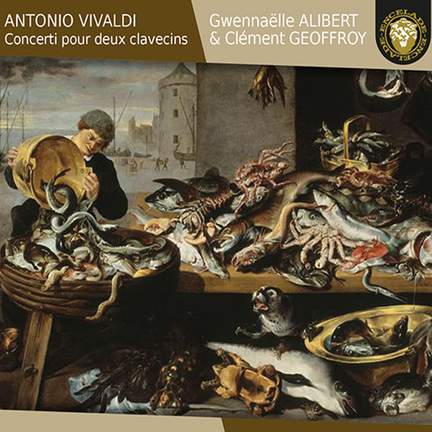
Vivaldi: Concerti pour deux Clavecins
Gwennaëlle Alibert, Clément Geoffroy (harpsichords)
Purchase product

About
« There is one essential question which immediately comes up if you want to play with two harpsichords and that is repertoire. Unfortunately there is little music written specifically for this configuration, compared to the enormous repertoire for solo harpsichord. Even so, there are a number of clues suggesting that this was a very widespread practice back in the 17th and 18th centuries.
As lovers of Vivaldi’s music - and frustrated that none of his works were written specifically for our instrument - we thus decided to perform them on two harpsichords. The addition of a second harpsichord is not a matter of merely doubling the instrument’s expressive possibilities, it actually increases them tenfold, providing the obvious alternation between Tutti and Soli, allowing us both to perform in stereo and to offer a much wider palette of nuances.
As we set to work, the first thing we had to do was to rewrite the left-hand parts. The bass parts which accompany the soli in Vivaldi’s music are often very simple, purely rhythmic devices with a crystal-clear harmony. They allow the continuo players to follow the soloist easily, and the latter can then express him or herself, giving his or her imagination free rein. The harpsichord, organ and theorbo can develop the harmony in their own ways and supplement the discourse with melodic performance. However, this simple bass part, usually played by two or three instrumentalists, seems rather dull if we just play it on the harpsichord alone, so we have altered it considerably, giving it a more melodic role (sometimes even that of a soloist) and expanding its range, in such a way as to fill out the harpsichord.
To end with, we must also mention one particular feature of the harpsichord. Although the virtuoso passages are perfectly-suited to the instrument, which gives them even more brilliance, the slow passages can be more difficult to reproduce. This is because the harpsichord does not have the ability to sustain sounds; once the note has been played, all that remains is to decide when to stop it, but the performer cannot either augment or diminish the sound as a bow or breath would do with a string or wind instrument. The only way of bringing long notes to life is to add trills to them or to ornament them with a melodic motif, which allows the vibration to be sustained. »
Clément Geoffroy & Gwennaëlle Alibert
Contents and tracklist
- Gwennaëlle Alibert (soloist), Clément Geoffroy (soloist)
- Gwennaëlle Alibert (soloist), Clément Geoffroy (soloist)
- Gwennaëlle Alibert (soloist), Clément Geoffroy (soloist)
- Gwennaëlle Alibert (soloist), Clément Geoffroy (soloist)
- Gwennaëlle Alibert (soloist), Clément Geoffroy (soloist)
- Gwennaëlle Alibert (soloist), Clément Geoffroy (soloist)
- Gwennaëlle Alibert (soloist), Clément Geoffroy (soloist)
- Gwennaëlle Alibert (soloist), Clément Geoffroy (soloist)
- Gwennaëlle Alibert (soloist), Clément Geoffroy (soloist)
- Gwennaëlle Alibert (soloist), Clément Geoffroy (soloist)
- Gwennaëlle Alibert (soloist), Clément Geoffroy (soloist)