
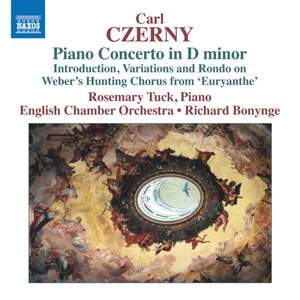


Special offer. Carl Czerny: Piano Concerto in D minor
Rosemary Tuck (piano)
English Chamber Orchestra, Richard Bonynge
Czerny produced much more besides teaching aides, including several piano concerto, the first of which receives – incredibly – its premiere recording here. Australian pianist Rosemary Tuck demonstrates...
Special offer. Carl Czerny: Piano Concerto in D minor
Rosemary Tuck (piano)
English Chamber Orchestra, Richard Bonynge
Purchase product
Czerny produced much more besides teaching aides, including several piano concerto, the first of which receives – incredibly – its premiere recording here. Australian pianist Rosemary Tuck demonstrates...
About
The Viennese-born Carl Czerny, student and confidant of Beethoven and teacher of Liszt, found fame in his native city by writing a series of fashionable pieces, among which numbered fantasies and potpourris as well as a series of important pedagogic studies. His large-scale pianistic works are of great interest and include the First Piano Concerto, in D minor, which expertly balances foreboding, pastoral richness and exuberant brio, a bravura Introduzione e Rondo Brillant and a vivacious salute to Weber’s Euryanthe. “Tuck is dazzlingly articulate and secure in the countless runs and fast passagework Czerny asks of her,” wrote MusicWeb International.
Contents and tracklist
- Rosemary Tuck (piano)
- English Chamber Orchestra
- Richard Bonynge

- Recorded: 14-16 December 2016
- Recording Venue: St Silas Church, Kentish Town, London, UK
Spotlight on this release
-
An error occurred.
Try watching this video on www.youtube.com, or enable JavaScript if it is disabled in your browser.
Awards and reviews
June 2018
Czerny produced much more besides teaching aides, including several piano concerto, the first of which receives – incredibly – its premiere recording here. Australian pianist Rosemary Tuck demonstrates the beauty and delicacy of the filigree melodies in the first movement, and the cadenza, written by Tuck and Alan Jones, glints and glitters…There is thoughtful balance between soloist and ensemble.
June 2018
Rosemary Tuck’s technical poise and genuine feeling for the idiom make a compelling case for these flawed but interesting works, while the balance between the soloist and the English chamber orchestra under Richard Bonynge’s solidly supportive leadership replicates the perspective one might perceive in a modest-sized concert hall.
Classical Music May 2018
The Introduzione e Rondo brillante dates from around 1833. There is rarely a cloud across its bright sparkling horizons, while the passagework of the Introduzione recalls Chopin. The ‘First Concerto’ of 1811/12, is expansive and dramatic; the exposed horn solos are beautifully played by High Seenan. Tuck plays her own brilliantly inventive cadenza, co-written with Alan Jones. Perhaps in the finale Czerny’s invention droops, but the concerto remains notable.