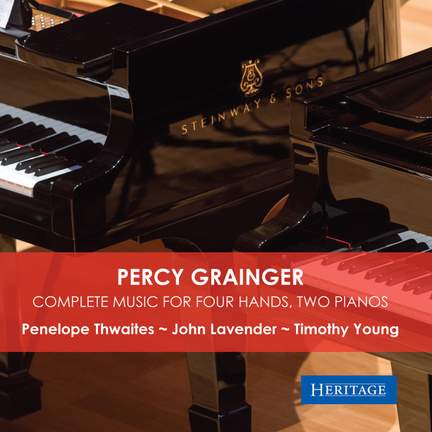
Percy Grainger: Complete Music for Four Hands, Two Pianos
Penelope Thwaites, John Lavender, Timothy Young
The music’s contrapuntal tapestries radiate with extra clarity, helped by Thwaites and Lavender’s rhythmic vim and the recording’s acoustic spread, with each piano clearly delineated. Grainger...
Percy Grainger: Complete Music for Four Hands, Two Pianos
Penelope Thwaites, John Lavender, Timothy Young
Purchase product

The music’s contrapuntal tapestries radiate with extra clarity, helped by Thwaites and Lavender’s rhythmic vim and the recording’s acoustic spread, with each piano clearly delineated. Grainger...
About
The music of Percy Grainger (1882–1961) for piano/s four hands ranges from a few intimate duets to a significant body of quasi-orchestral concert works. The great majority were written for two instruments and they exploit this rich resource to the full. Given that almost all were originally works for chamber, orchestral, wind-band or choral forces, pianists have the widest possible range of sound references. Leading Grainger scholar and performer, Penelope Thwaites, has newly recorded a fourth CD with fellow Australian pianist, Timothy Young, to add to the three existing CDs of Grainger’s music she recorded with John Lavender for the Pearl label in the 1990s. All four CDs contain many world premieres and provide a fascinating insight into Grainger’s pianistic output.
Contents and tracklist
- Penelope Thwaites, John Lavender
- Penelope Thwaites, John Lavender
- Penelope Thwaites, John Lavender
- Penelope Thwaites, John Lavender
- Penelope Thwaites, John Lavender
- Penelope Thwaites, John Lavender
- Penelope Thwaites, John Lavender
- Penelope Thwaites, John Lavender
- Penelope Thwaites, John Lavender
- Penelope Thwaites, John Lavender
- Penelope Thwaites, John Lavender
- Penelope Thwaites, John Lavender
- Penelope Thwaites, John Lavender
- Penelope Thwaites, John Lavender
Awards and reviews
 February 2017
The music’s contrapuntal tapestries radiate with extra clarity, helped by Thwaites and Lavender’s rhythmic vim and the recording’s acoustic spread, with each piano clearly delineated. Grainger might not be a ‘great’ composer, but I can’t think of another who so quickly and quirkily enhances life.