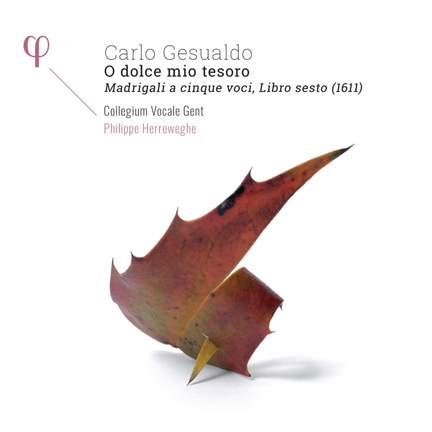
Gesualdo: O Dolce Mio Tesoro
Sesto Libro Di Madrigali, 1611
Collegium Vocale Gent, Philippe Herreweghe
In items such as Già pense the performers demonstrate an understanding that not all of these madrigals are morbid (fewer than half mention death), and they deck out the sound with warm chords...
Gesualdo: O Dolce Mio Tesoro
Sesto Libro Di Madrigali, 1611
Collegium Vocale Gent, Philippe Herreweghe
Purchase product

In items such as Già pense the performers demonstrate an understanding that not all of these madrigals are morbid (fewer than half mention death), and they deck out the sound with warm chords...
About
A personality has who provoked considerable controversy over the centuries, Carlo Gesualdo (1566-1613), aristocrat, musician and murderer of his first wife, is no less a composer whose music is marked by subtlety and refinement. His innovative Sixth Book of Madrigals, written two years before his death, exploits all harmonic, chromatic, and textural possibilities to meet the texts’ expressive requirements and proves to be a veritable masterpiece of the genre.
After a first disc devoted to the Italian composer’s sacred works, the Tenebrae Responsoria, Philippe Herreweghe and his Collegium Vocale Gent invite us to (re)discover his secular music for the 450th anniversary of his birth. In masterful fashion, they propose a delicate, expressive reading of this complex music, doing justice to the modernity of the musical language of the Prince of Venosa. The acoustics of the church in the little Tuscan village of Asciano, where the programme was recorded in 2015, provides an ideal sound setting for this music.
Contents and tracklist
- Collegium Vocale Gent, Philippe Herreweghe
- Recorded: 1-3 August 2015
- Recording Venue: Chiesa San Francesco, Asciano, Italy
Spotlight on this release
-
An error occurred.
Try watching this video on www.youtube.com, or enable JavaScript if it is disabled in your browser.
Awards and reviews
 April 2017
In items such as Già pense the performers demonstrate an understanding that not all of these madrigals are morbid (fewer than half mention death), and they deck out the sound with warm chords and quicksilver, joyous runs.
 February 2017
Herreweghe’s singers are well matched…they are light on their feet, which suite his approach…at its best the beauty of the Collegium’s voices is very impressive
 18th November 2016
The slippery harmonies of Carlo Gesualdo’s sixth book of madrigals, written in 1611 but sounding centuries ahead of their time, are nailed down with the sharpest, slenderest of pins thanks to the perfect tuning and clear tone of Herreweghe’s ensemble. One to each line, the singers maintain a finely balanced blend, emerging briefly as soloists at moments of emphasis