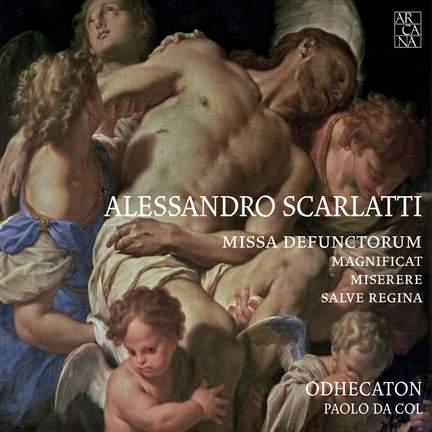
Alessandro Scarlatti: Missa defunctorum
Odhecaton, Paolo Da Col
Awards:
-
Gramophone Magazine, January 2017, Editor's Choice

-
Gramophone Awards, 2017, Shortlisted - Baroque Vocal

The interweaving voices produce an attractive juxtaposition of density and transparency. Texts are declaimed crisply yet sensitively, melismatic vowels possess compassionate luminosity, and...
Alessandro Scarlatti: Missa defunctorum
Odhecaton, Paolo Da Col
Purchase product

Awards:
-
Gramophone Magazine, January 2017, Editor's Choice
-
Gramophone Awards, 2017, Shortlisted - Baroque Vocal
The interweaving voices produce an attractive juxtaposition of density and transparency. Texts are declaimed crisply yet sensitively, melismatic vowels possess compassionate luminosity, and...
About
This recording is a discovery of Alessandro Scarlatti’s heretofore unknown sacred music, where Renaissance tradition meets Baroque sensibility for a unique and compelling recording. At the core of Odhecaton’s latest offering is the Missa defunctorum for four voices and basso continuo. It is in this magnificent score – recorded for the first time using the critical edition of Luca Della Libera – that primarily contrapuntal writing gives way to Scarlatti’s stylistic choices of great expressivity and rhetorical force, such as in the case of the astonishing Lacrimosa. The Miserere is also recorded for the first time. Written for nine voices for the Sistine Chapel, the score follows Allegri’s model only outwardly; Scarlatti, in fact, moves steadily away from it through his harmonic originality, formal richness, and expressivity. The Magnificat displays a unique synthesis of the Palestrinian model and the expressive language of the eighteenth century. In this score, Scarlatti exploits the great wealth and variety of the Marian text, particularly in the relationship between words and the emotional and descriptive spheres.
Contents and tracklist
- Odhecaton, Paolo Da Col
- Recorded: 5-8 December 2015
- Recording Venue: Oratorio degli Angeli Custodi, Lucca, Italy
- Odhecaton, Paolo Da Col, Alessandro Carmignani, Andrea Arrivabene, Vincenzo Di Donato, Enrico Bava
- Recorded: 5-8 December 2015
- Recording Venue: Oratorio degli Angeli Custodi, Lucca, Italy
- Odhecaton, Paolo Da Col
- Recorded: 5-8 December 2015
- Recording Venue: Oratorio degli Angeli Custodi, Lucca, Italy
- Odhecaton, Paolo Da Col, Alena Dantcheva
- Recorded: 5-8 December 2015
- Recording Venue: Oratorio degli Angeli Custodi, Lucca, Italy
Spotlight on this release
-
An error occurred.
Try watching this video on www.youtube.com, or enable JavaScript if it is disabled in your browser.
Awards and reviews
-
Gramophone MagazineJanuary 2017Editor's Choice
 January 2017
The interweaving voices produce an attractive juxtaposition of density and transparency. Texts are declaimed crisply yet sensitively, melismatic vowels possess compassionate luminosity, and plangent contrapuntal contours illuminate Scarlatti’s harmonic chiaroscuro. The highlight is the chromatically charged ‘Lacrimosa’, its exquisite dissonances and harmonic twists redolent of Gesualdo.