

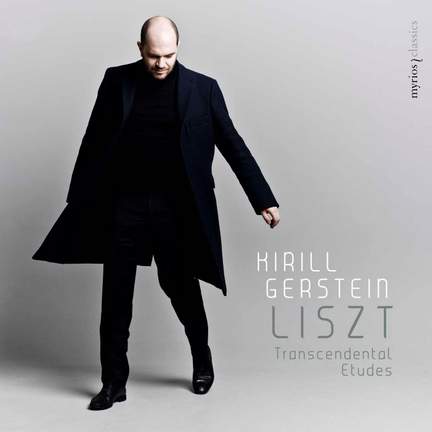
Liszt: Transcendental Studies, S139 Nos. 1-12
Kirill Gerstein (piano)
Awards:
-
Gramophone Magazine, July 2026, Editor's Choice

amazing keyboard dexterity … ultra-clear articulation
Liszt: Transcendental Studies, S139 Nos. 1-12
Kirill Gerstein (piano)
Purchase product

Awards:
-
Gramophone Magazine, July 2026, Editor's Choice
amazing keyboard dexterity … ultra-clear articulation
About
"Liszt‘s Transcendental Etudes are a quintessential distillation of the mid-19th century romantic project: they’re like sounding images of romanticism’s nervous system, its otherworldly experiences, and its transcendence." Tom Service (excerpt from the liner notes interview with Kirill Gerstein)
The multi-faceted pianist Kirill Gerstein has rapidly ascended into classical music’s highest ranks. With a masterful technique, discerning intelligence, and a musical curiosity that has led him to explore repertoire spanning centuries and styles, he has proven to be one of today’s most intriguing and versatile musicians. His early training and experience in jazz has contributed an important element to his interpretive style, inspiring an energetic and expressive musical personality that distinguishes his playing.
Contents and tracklist
Awards and reviews
-
Gramophone MagazineJuly 2026Editor's Choice
 November 2016
amazing keyboard dexterity … ultra-clear articulation
 28th July 2016
The technical challenges of these 12 studies are daunting, but they have individual characters, too. Gerstein plays them without any sense of being stretched, finds time to create poetry and drama, and is sparing with his big guns. “Feux follets”, a familiar favourite, is magical. “Wilde Jagd” is at once a headlong chase and a model of restraint. In these imaginative performances the whole set adds up to more than the sum of its parts.
 September 2016
From the opening Preludio...we gather that Gerstein is no mere showman but a storyteller who, even at the height of Liszt’s ferocious challenges, lets the music breathe, controlling its ebb and flow with enormous skill.You won’t, I think, hear better versions of Nos 11 and 12...Overall, it’s a terrific achievement.
 17th July 2016
Gerstein, a superb interpreter, seeks and convincingly finds the work’s grand unity — his thoughts on the matter are revealed in the lucid booklet interview, but, more important, in the ever-sensitive playing itself...the unfolding is gripping, intricately fascinating and uniquely poetic.
 24th July 2016
Gerstein had an early encounter with jazz before deciding, aged 16, to becoming a classical pianist. Perhaps that knowledge of improvisation, together with a sharp, analytical approach, gives his playing its distinctive freedom, risk and excitement.
 20/08/16
listen to the ruminative close of Paysage, the robust masculinity of the fiery Mazeppa, the will-o’-the-wisp delicacy of Feux Folets, the magisterial flamboyance of Eroica, or the wild (though tightly controlled) frenzy of Wilde Jagd – Gerstein presents them as one magical discovery after another. His tonal vocabulary is considerable, and while detail is paramount, the big picture is potent and foremost
Classical Music October 2016
As exciting, fresh and beautiful a complete set of these studies as this reviewer has heard … Throughout there is an improvisatory freedom placed always at the service of, rather than distracting from, these remarkable pieces.
 6th August 2016
This disc of Liszt’s 12 Transcendental Etudes is dizzyingly good … it’s to Gerstein’s credit that the musical values triumph over empty virtuosity. There are moments when you want to giggle with incredulity at what you’re hearing…thrilling stuff – Gerstein’s playing combines technical brilliance with a beating heart, and the close, rich recording adds to the disc’s impact.
Classical Ear 5th September 2016
Kirill Gerstein has no misconceptions of the genius behind these Etudes, and his technique matches the transcendental demands of these works.
Record Review 17th September 2016
His playing has a delicate relaxation, a playfulness, he’s comfortable with letting the pulse just hang in the air, he can be drivingly rhythmic when he needs to be, with a great feel for time and colour … We have a pianist here for whom technique is almost secondary, he’s a step beyond it, and that’s an important aspect of what these transcendental studies represent.
