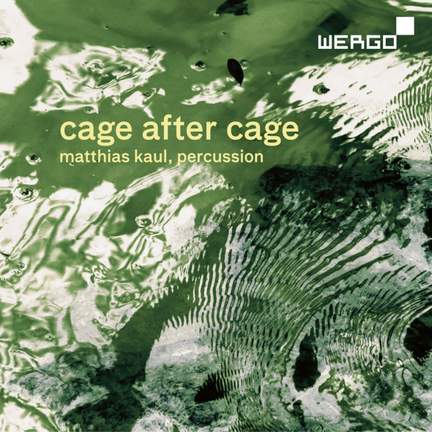
Cage after Cage. Works for Solo Percussion
Matthias Kaul (percussion)
Cage often leaves instrumentation up to the performer and Kaul tends towards the gentle, mellow, quirky and mysterious. He keeps his touch light and his timbres tactile. He has a knack for making...
Cage after Cage. Works for Solo Percussion
Matthias Kaul (percussion)
Purchase product

Cage often leaves instrumentation up to the performer and Kaul tends towards the gentle, mellow, quirky and mysterious. He keeps his touch light and his timbres tactile. He has a knack for making...
About
Anyone performing John Cage’s music cannot avoid the phenomenon of silence. In his view, everything audible can in principle be music, even if it is not composed: “If you want to know the truth of the matter, the music I prefer, even to my own or anybody else's, is what we are hearing if we are just quiet.”
In all the works interpreted by him, Matthias Kaul deals with the question of which forms can principally take silence and how it can be realised in the most concrete way: which instruments are used, how does the instrumentation develop throughout the entire piece, and how can the acoustic results remain exciting for almost half an hour? How can a large number of instruments and sounds be brought into play without conveying the impression of arbitrariness?
The playing instructions for 'Inlets' are rudimentary: there are three performers, each of whom has four conch shells. The shells are filled with water and turned round and round; then a fire fuelled by pine cones begins, and the piece ends with a tone from one of the shells blown like a horn.
In 'Child of Tree', Cage's instructions present a rather diffuse area of possibilities. The performer must toss coins and decide on the basis of the results as to how many sections he divides the eight minutes into and which instruments he uses in which sections.
In 'Composed Improvisation', Cage gave exact instructions consisting of time brackets which provide a timeframe for the music. The tonal structure within this framework is left to chance.
'27´10.554'' for solo percussion is a finished composition of this project, with the title indicating the duration of the piece. For this major project, Kaul used 90 different instruments and objects altogether.
Contents and tracklist
- Matthias Kaul
- Matthias Kaul
- Matthias Kaul
- Matthias Kaul
- Matthias Kaul
Awards and reviews
 January 2016
Cage often leaves instrumentation up to the performer and Kaul tends towards the gentle, mellow, quirky and mysterious. He keeps his touch light and his timbres tactile. He has a knack for making percussion instruments sound like human voices, which can be uncanny.