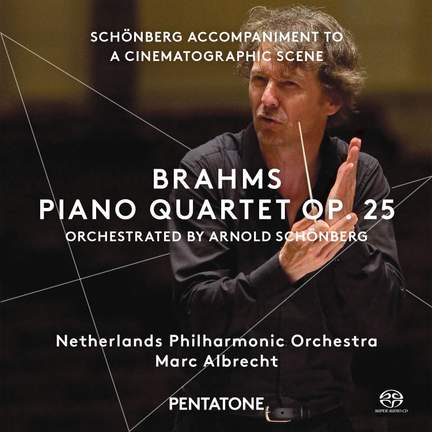
Brahms/Schoenberg: Piano Quartet Op. 25
Netherlands Philharmonic Orchestra, Marc Albrecht
the Netherlanders are more ardent in the songful slow movement, more upbeat in its central march, and far more exciting in the headlong Hungarian gypsy finale.
Brahms/Schoenberg: Piano Quartet Op. 25
Netherlands Philharmonic Orchestra, Marc Albrecht
Purchase product

the Netherlanders are more ardent in the songful slow movement, more upbeat in its central march, and far more exciting in the headlong Hungarian gypsy finale.
About
Composer Arnold Schönberg considered it vitally important to study the techniques of other composers in order to thus penetrate more deeply into the true content of their music ⎯ and he believed the best way to do this was by arranging the original compositions. And thus between May and September 1937, Schönberg penned an orchestral version of the Piano Quartet in G minor by Johannes Brahms. His first reason was personal: “I like the piece.” But the other two were more of a practical nature. “It is seldom played.
It is always very badly played, because the better the pianist, the louder he plays, and you hear nothing from the strings. I wanted for once to hear everything, and this I have achieved.”
In this regard, conductor Marc Albrecht and Netherlands Philharmonic Orchestra prevail, with individual instruments and sections coming forward in carefully drawn sections. It is a fun Quartet, and one that is brilliantly played by Albrecht and the orchestra. Furthermore, Albrecht’s style suits the composition, with its grand, impressive gestures and vivid colour to the music. When asked why he is so enthusiastic about the composition Marc Albrecht replies, “Schönberg’s contributions made it a true orchestral work: American with a Schönberg-like sound. It is a fantastic trip through an insanely good piece.”
Recorded at the orchestra’s impressive residence ⎯ the NedPhO-Koepel, formerly the Majella church ⎯ this album also features Schönberg’s own work, Begleitmusik zu einer Lichtspielscene (which translates as ‘Accompaniment to a cinematic scene’). Although the work reflected the customs of silent movies, Schönberg’s original score could not be used for film as it was not possible to adapt the music to the length of the scenes. The première was held in Frankfurt in 1930, without an accompanying film, and led by conductor Hans Rosbaud. Schönberg’s idea was not fulfilled until 1973, when three films by Jean-Marie Straub, Jan W. Morthenson and Luc Ferrari respectively were made to accompany the score.
Contents and tracklist
Awards and reviews
 December 2015
the Netherlanders are more ardent in the songful slow movement, more upbeat in its central march, and far more exciting in the headlong Hungarian gypsy finale.
 September 2015
Marc Albrecht cultivates an orchestral blend plausibly akin to something Brahms might have done with the piece…[his] tempi honour the scale of the original, the rhythms are nicely sprung and he uses the orchestration to mould the contrasting themes of each movement more than exaggerated shifts and transitions between them.