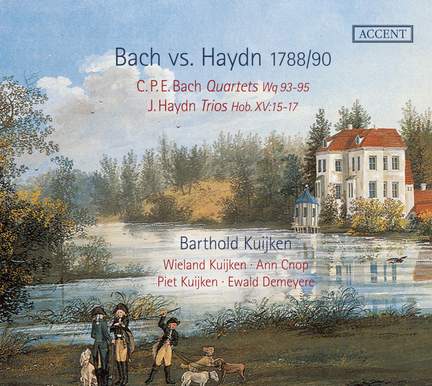
Bach versus Haydn 1788/90
Barthold Kuijken (traverso), Wieland Kuijken (cello CD1), Ann Cnop (viola CD2), Piet Kuijken (fortepiano CD1), Ewald Demeyere (harpsichord CD2)
Kuijken plays with great panache, in a really speechlike manner, with clear dynamic accents...This is Haydn at his very best. The overall quality of these performances and the combination of...
Bach versus Haydn 1788/90
Barthold Kuijken (traverso), Wieland Kuijken (cello CD1), Ann Cnop (viola CD2), Piet Kuijken (fortepiano CD1), Ewald Demeyere (harpsichord CD2)
Purchase product

Kuijken plays with great panache, in a really speechlike manner, with clear dynamic accents...This is Haydn at his very best. The overall quality of these performances and the combination of...
About
'Bach versus Haydn' – in replying to the question as to the reason for this programme compilation, Barthold Kuijken states that these compositions are amongst the very best works ever written for the flute by Carl Philipp Emanuel Bach and Joseph Haydn. A comparison of these work groups, so very different in their respective styles, is exciting because they were created at almost the same time. C.P.E. Bach wrote the Quartets, Wq 93-95 during the year 1788 in Hamburg; Haydn composed the Trios, Hob XV: 15-17 1789/90 in Vienna/Eszterháza – a good ten years after Mozart's well-known Flute Quartet in D major, K285 of 1777.
These Quartets are amongst C.P.E. Bach's very best creations; he was to die a year after they were composed. Haydn wrote the Trios at the end of his period with the Eszterházys. The death of Prince Nikolaus I in late 1790 broke Haydn's close ties with the court and he was able to earn a living from his work from that time onward as a freelance artist. The stylistic differences between the two are enormous. In Bach, we find Sturm und Drang (storm and stress), Empfindsamkeit (sensitivity), contrasts, the unexpected…, in Haydn, alongside his typical wit and moving depth, we find (apparent) simplicity, clear form, elegance, charm and the cantabile quality of Viennese Classicism.
Contents and tracklist
- Barthold Kuijken (flute), Wieland Kuijken (cello), Piet Kuijken (fortepiano)
- Recorded: September 2014
- Recording Venue: AMUZ, Antwerp, Belgium
- Barthold Kuijken (flute), Wieland Kuijken (cello), Piet Kuijken (fortepiano)
- Recorded: September 2014
- Recording Venue: AMUZ, Antwerp, Belgium
- Barthold Kuijken (flute), Wieland Kuijken (cello), Piet Kuijken (fortepiano)
- Recorded: September 2014
- Recording Venue: AMUZ, Antwerp, Belgium
- Barthold Kuijken (flute), Ann Cnop (viola), Ewald Demeyere (harpsichord)
- Recorded: September 2014
- Recording Venue: AMUZ, Antwerp, Belgium
- Barthold Kuijken (flute), Ann Cnop (viola), Ewald Demeyere (harpsichord)
- Recorded: September 2014
- Recording Venue: AMUZ, Antwerp, Belgium
- Barthold Kuijken (flute), Ann Cnop (viola), Ewald Demeyere (harpsichord)
- Recorded: September 2014
- Recording Venue: AMUZ, Antwerp, Belgium
Awards and reviews
 October 2015
Kuijken plays with great panache, in a really speechlike manner, with clear dynamic accents...This is Haydn at his very best. The overall quality of these performances and the combination of two series of pieces which are so characteristic of their respective composers make this set a winner. Even if you have good recordings of these works in your collection there is every reason to add this set.