CPE Bach: Gamba Sonatas
Alberto Rasi (viola da gamba), Patrizia Marisaldi (harpsichord) & Claudia Pasetto (viola da gamba)
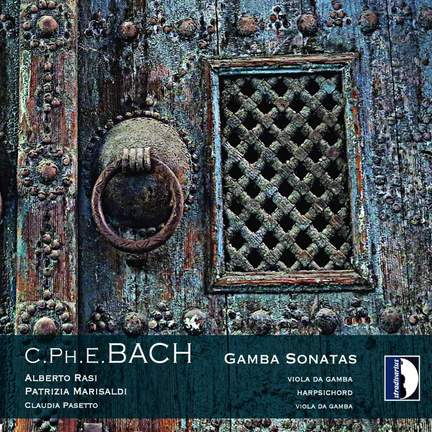
CPE Bach: Gamba Sonatas
Alberto Rasi (viola da gamba), Patrizia Marisaldi (harpsichord) & Claudia Pasetto (viola da gamba)
Purchase product

About
The last decade of the 18th century was the last of the viola da gamba: this is confirmed in the registers of musical chapels around mid century which clearly show the progressive reduction, to the point of disappearance, of viola da gamba players, while the number of cellists grew. Nonetheless, the viola da gamba could count on very fertile ground like that of Frederick II’s court at Potsdam, already identified at the time as the 'School of Berlin'. By the 1780s this group produced a viola corpus of about 50 works attributable to seven composers. Among these was the violist Ludwig Christian Hesse, who joined Potsdam in 1741, together with Carl Philipp Emanuel Bach, and whose father, Hernst Christian, a famous virtuoso, had learnt French viola playing directly from Marin Marais and Antoine Forqueray during a stay in Paris from 1698 to 1701. The stylistic metamorphosis of the viola da gamba would find its most complete and definitive realisation in the berlin setting.
These sonatas are in three movements, in the order slow-fast-fast, based on the Italian model; very different in style from the French pièces produced until the middle of the century. Above all, it is music which was born in a restricted professional context and not conceived, like the French music, for the vast number of amateurs (none of these works appears in contemporaneous printed form). Moreover, the chronological, environmental and cultural consistency of the 'Berlin School', which in Frederick II had its strong figure of reference, enabled this viola centre to maintain a constant and exclusive uniformity of style.
Contents and tracklist
- Patrizia Marisaldi, Alberto Rasi
- Claudia Pasetto, Patrizia Marisaldi, Alberto Rasi
- Claudia Pasetto, Patrizia Marisaldi, Alberto Rasi