Special offer. Poulenc: Stabat mater
Carolyn Sampson (soprano)
Cappella Amsterdam, Estonian Philharmonic Chamber Choir & Estonian National Symphony Orchestra, Daniel Reuss
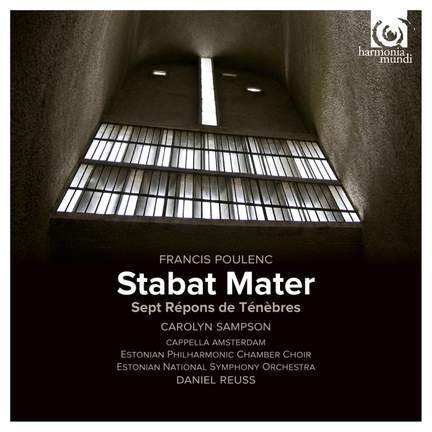
The word 'powerful' is not one we naturally associate with Poulenc...Still, these are vivid and, yes, powerful performances.
Special offer. Poulenc: Stabat mater
Carolyn Sampson (soprano)
Cappella Amsterdam, Estonian Philharmonic Chamber Choir & Estonian National Symphony Orchestra, Daniel Reuss
Purchase product

The word 'powerful' is not one we naturally associate with Poulenc...Still, these are vivid and, yes, powerful performances.
About
Poulenc’s 'Stabat Mater', which he described as a ‘requiem without despair’, was written in 1950 following the death of Christian Bérard who designed the sets for Cocteau’s films and plays and was a leading figure of 1940s Paris. This masterly work, dedicated to the Virgin of Rocamadour, gives pride of place to the chorus and clearly shows its line of descent from the French grands motets. On completing it, Poulenc wrote to Pierre Bernac: "It’s good, because it’s completely authentic".
From the time of his pilgrimage to Rocamadour in 1936, Poulenc's religious output was filtered through his Catholic interpretation of the world and his personal trajectory. The 'Stabat Mater' is no exception to this rule, in that it associates the events and circumstances of his own life with the drama of the Gospels. It identifies the three figures of Christ, the Virgin and the Faithful Disciple with biographical figures: Bérard, Poulenc, and the latter’s lover Lucien Roubert, whom he was to refer to as ‘the secret’ of the 'Stabat Mater' and 'Dialogues des Carmélites'.
In December 1959 Leonard Bernstein commissioned a new work from Poulenc for the New York Philharmonic Orchestra. He chose to write the 'Sept Répons des Ténèbres' (Seven Tenebrae Responses) for treble soloist, a chorus of boys’ and men’s voices and symphony orchestra. The posthumous first performance took place on 11 April 1963 at Philharmonic Hall (now Avery Fisher Hall) under the direction of Thomas Schippers. Poulenc had insisted on these all-male vocal forces, but, 50 years after his death, it is important to allow for more widespread performance of this fascinating score which has too long languished in the shadows.
Contents and tracklist
Awards and reviews
 May 2014
The word 'powerful' is not one we naturally associate with Poulenc...Still, these are vivid and, yes, powerful performances.
 May 2014
Sampson eloquently expresses the isolation and apprehension of the solo line [in the Sept Répons], and the mixed voices...sensitively and dramatically project the sombre, fearful, abject world in which Poulenc finds himself. Theirs is also a fine performance of the Stabat Mater...The choir and orchestra rise fully to the eruptions of emotion.
 April 2014
This is a beautiful recording, and a valuable coupling of Poulenc’s two most serious works for chorus and orchestra … Very warmly recommended.
 9th April 2014
Carolyn Sampson is a wonderful soloist and the combined choirs, which number just short of fifty singers, perform Poulenc’s varied and demanding music expertly...The splendid performances on this disc make the best possible case for Poulenc’s sacred music.