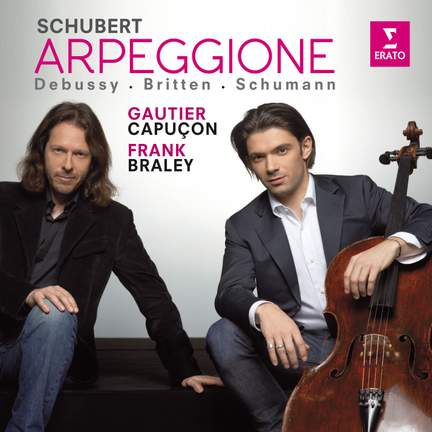
Schubert: Arpeggione
Gautier Capuçon (cello) & Frank Braley (piano)
these are fine, clear accounts. The Schubert may lack the dream-like quality Britten and Rostropovich find, but its Adagio is presented with long, elegantly spun phrases, due tenderness and...
Schubert: Arpeggione
Gautier Capuçon (cello) & Frank Braley (piano)
Purchase product

these are fine, clear accounts. The Schubert may lack the dream-like quality Britten and Rostropovich find, but its Adagio is presented with long, elegantly spun phrases, due tenderness and...
About
This collection of works for cello and piano, with Schubert’s Arpeggione Sonata as its centrepiece, sees Gautier Capuçon and Frank Braley paying tribute to two towering musicians of the 20th century, Mstislav Rostropovich and Benjamin Britten, who recorded all four of the works on the programme: Schubert’s ‘Arpeggione’ Sonata, Debussy’s Cello Sonata, Schumann’s Fünf Stücke im Volkston and Britten’s own Cello Sonata in five movements, which received its first performance at the Aldeburgh Festival in 1961, two years after composer and cellist had first met. “It is a magnificent piece,” says Gautier Capuçon of the Britten, “and too rarely played as far as I’m concerned. I grew up with Britten’s children’s opera The Little Sweep, so I am well acquainted with his language.” Moreover, 2013 marks the 100th anniversary of Britten’s birth.
Schubert wrote the Arpeggione Sonata – conceived for the eponymous six-stringed fretted instrument, but now standard repertoire for cello – in 1824, when he was already desperately ill and suffering from crushing bouts of depression. “It is a work that has always profoundly touched and moved me,” says Capuçon, “There is such greatness of feeling in it, even though Schubert was in the depths of despair. As Beethoven is reputed to have said: ‘Truly, in Schubert there dwells a divine spark!’
Debussy’s Cello Sonata was also written at dark time, in 1915, the second year of the First World War, when the composer was already ill with the cancer that was to kill him in 1918; yet it is a work of both sober elegance and mercurial fantasy from this archetypal musicien français – the words with which Debussy signed the score. Schumann’s Fünf Stücke im Volkston (Five Pieces in the Popular Style) were written in 1849, a productive time for the composer, even though he, too, was suffering from ill health – signs of the mental disturbances that were to lead to a suicide attempt five years later. Again, these are not dark works, but lyrical and accessible.
Contents and tracklist
Spotlight on this release
-
An error occurred.
Try watching this video on www.youtube.com, or enable JavaScript if it is disabled in your browser.
Awards and reviews
 February 2014
these are fine, clear accounts. The Schubert may lack the dream-like quality Britten and Rostropovich find, but its Adagio is presented with long, elegantly spun phrases, due tenderness and limpid clarity...their Debussy Sonata has the greatest sense of elan, and is full of character and pungent sensuality.
 February 2014
this recording is an accomplishment in both duo playing and musical insight, and everything on it is unforced and unfussy, but perfectly idiomatic in its own way...[it] is the Debussy that is stand-out performance on this disc, played by both as if it were truly in their blood.
 6th February 2014
The obvious task for this reviewer was to compare the new recordings with those of Rostropovich and Britten. Overall, I find Capuçon and Braley in no way inferior to those legends...I heartily commend this disc for all lovers of cello/piano music. Capuçon and Braley give superb performances...The recorded sound is close, but not at all claustrophobic
 12th December 2013
Braley finds fierceness in some of the keyboard writing, while Capuçon's tone twists from lingering nostalgia to no-nonsense assertiveness. It's a considerable achievement.