Special offer. Duport: Etudes (21) for Violoncello
Alessandro Andriani (cello) & Simone Ceppetelli (cello continuo)
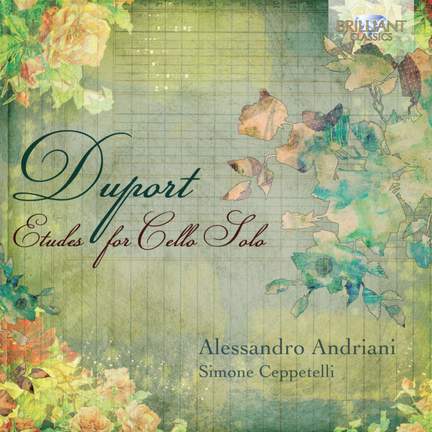
Special offer. Duport: Etudes (21) for Violoncello
Alessandro Andriani (cello) & Simone Ceppetelli (cello continuo)
Purchase product

About
Born in Paris in 1749, Jean‐Louis Duport, cellist and composer, also known as ‘le jeune’ – to distinguish him from his elder brother Jean‐Pierre (1741–1818), called ‘l’ainé’ – is today regarded as one of the most important figures in the history of the development and evolution of cello technique. In 1806 he published his cello treatise Essai sur le doigté du violoncelle et sur la conduite de l’archet, a work that became the fundamental reference point for all subsequent schools of cello teaching. At the end of the treatise, we find the 21 Etudes for Violoncello (with a second cello part as accompaniment), works that explain and put into practice the methods described within. They are very difficult, highly virtuosic exercises that present a wide selection of tones and bowings as well as an extraordinary richness of compositional ideas, and in this way the Essai can be viewed as an anthology of concert pieces with real artistic value rather than just a mere practical handbook.
Made following precise philological criteria and with attention to the performing practice of the age, this recording includes a second cello as accompaniment (the instrument assumes the role of continuo, developing the performance and enlivening the listening experience) and employs original instruments with gut strings and historical bows. Thanks more to their difficulty and pedagogical reputation, the Etudes may have been rarely recorded, a fact which only adds value to the present issue, but they repay repeated listening for their élan, and will be required listening not only for cello students seeking to master the Etudes themselves but also for anyone with a passing interest in the music of Classical era France.
Contents and tracklist
- Alessandro Andriani (cello), Simone Ceppetelli (cello)
- Alessandro Andriani (cello), Simone Ceppetelli (cello)
- Alessandro Andriani (cello), Simone Ceppetelli (cello)
- Alessandro Andriani (cello), Simone Ceppetelli (cello)
- Alessandro Andriani (cello), Simone Ceppetelli (cello)
- Alessandro Andriani (cello), Simone Ceppetelli (cello)
- Alessandro Andriani (cello), Simone Ceppetelli (cello)
- Alessandro Andriani (cello), Simone Ceppetelli (cello)
- Alessandro Andriani (cello), Simone Ceppetelli (cello)
- Alessandro Andriani (cello), Simone Ceppetelli (cello)
- Alessandro Andriani (cello), Simone Ceppetelli (cello)
- Alessandro Andriani (cello), Simone Ceppetelli (cello)
- Alessandro Andriani (cello), Simone Ceppetelli (cello)
- Alessandro Andriani (cello), Simone Ceppetelli (cello)
- Alessandro Andriani (cello), Simone Ceppetelli (cello)