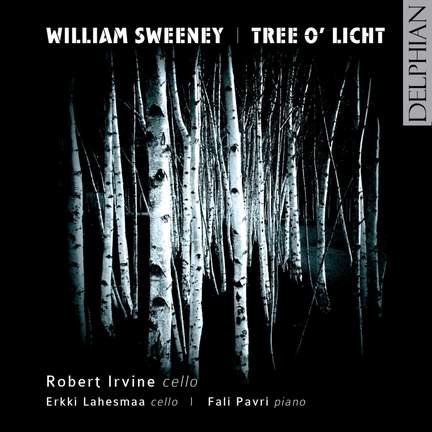
William Sweeney: Tree o’ Licht
Robert Irvine (cello), Erkki Lahesmaa (cello) & Fali Pavri (piano)
a style that seems to manage to have it both ways, preserving the expressive possibilities and archetypes of the Scottish folk tradition within an idiom that can call on techniques and technology...
William Sweeney: Tree o’ Licht
Robert Irvine (cello), Erkki Lahesmaa (cello) & Fali Pavri (piano)
Purchase product

a style that seems to manage to have it both ways, preserving the expressive possibilities and archetypes of the Scottish folk tradition within an idiom that can call on techniques and technology...
About
Both musically impassioned and socially engaged, William Sweeney’s music is at its most eloquent when voiced by that most human of instruments, the cello. The player navigates a stormy electronic landscape in the Borges-inspired 'The Poet Tells of his Fame', while Schumann lies behind the powerfully argued Sonata for Cello and Piano, recipient of a 2011 BASCA British Composer Award.
The Sonata bears a joint dedication to Delphian artist Robert Irvine and to Erkki Lahesmaa - ‘keepers’, as Sweeney calls them, ‘of the cello’s inner voice’ - and Irvine is joined by his Finnish colleague here in the 2008 duo 'The Tree o’ Licht', in which Gaelic Psalmody is transmuted into deepest instrumental expressivity.
World premiere recordings made in the presence of the composer.
Contents and tracklist
- Robert Irvine (cello), Erkki Lahesmaa (cello)
- Recorded: 2, 3 November, 13, 14 December 2012
- Recording Venue: Concert Hall, University of Glasgow, UK
- Robert Irvine (cello), William Sweeney (electronics)
- Recorded: 2, 3 November, 13, 14 December 2012
- Recording Venue: Concert Hall, University of Glasgow, UK
- Robert Irvine (cello), Fali Pavri (piano)
- Recorded: 2, 3 November, 13, 14 December 2012
- Recording Venue: Concert Hall, University of Glasgow, UK
Awards and reviews
 25th July 2013
a style that seems to manage to have it both ways, preserving the expressive possibilities and archetypes of the Scottish folk tradition within an idiom that can call on techniques and technology from the whole modernist tradition since 1945...Simple and beautifully achieved.
The Classical Reviewer 14th September 2013
A distinctively Scottish feel, beautifully created by the two cellos, drawing one in immediately with its entrancing atmosphere...This is an extremely rewarding release of works that are often quite beautiful and affecting