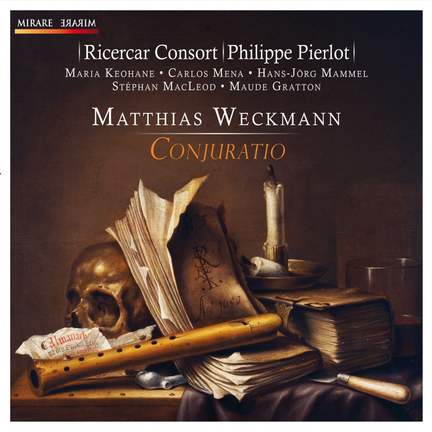
Matthias Weckmann: Conjuratio
Maria Keohane (soprano), Carlos Mena (alto), Hans-Jorg Mammel (tenor), Stephan MacLeod (bass) & Maude Gratton (organ)
Ricercar Consort, Philippe Pierlot
This is an outstanding recording of six fine and substantial sacred concertos and three equally powerful organ works, played on the notable Schnitger-based instrument at Steinkirchen… I really...
Matthias Weckmann: Conjuratio
Maria Keohane (soprano), Carlos Mena (alto), Hans-Jorg Mammel (tenor), Stephan MacLeod (bass) & Maude Gratton (organ)
Ricercar Consort, Philippe Pierlot
Purchase product

This is an outstanding recording of six fine and substantial sacred concertos and three equally powerful organ works, played on the notable Schnitger-based instrument at Steinkirchen… I really...
About
Weckmann's musical training took place in Dresden under the direction of Heinrich Schütz, then in Hamburg where he worked with Praetorius. Weckmann travelled to Denmark in 1637 with Schütz, where his Lüneberg manuscript has been lurking, wrongly attributed to Christoph Bernhard. Weckmann became organist in Dresden at the Electoral Court of Saxony from 1638 to 1642, and returned to Denmark until 1647 (during the Thirty Years' War).
During a new (and his last) stay in Dresden from 1649 to 1655, he met Johann Jakob Froberger during a musical competition which had been organised by the Elector. They remained friends and in correspondence with each other. In 1655, after a competition, he was named titular organist at Saint James church (Jakobkirche) in Hamburg, and spent his remaining life there. He founded a renowned orchestral ensemble, the so-called Collegium Musicum in Hamburg in 1660. This was the most productive period of his life: his compositions of this time include this collection of 1663, which sets visionary settings of biblical texts evoking images of desolation and destruction, but also struggle and hope. It was inspired by the terrible plague which killed his first wife and many of his colleagues in Hamburg that year, including Heinrich Scheidemann.
Matthias Weckmann died in Hamburg c1674 and was buried in a family grave in the Jacobkirche, beneath the organ.
Contents and tracklist
Awards and reviews
Early Music Review June 2013
This is an outstanding recording of six fine and substantial sacred concertos and three equally powerful organ works, played on the notable Schnitger-based instrument at Steinkirchen… I really can’t imagine anyone with early music sympathies listening to the first thirty seconds of track 1 and not being hooked for the next hour or so.