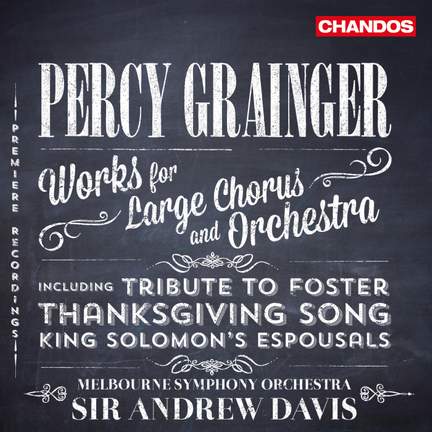
Special offer. Grainger: Works for Large Chorus and Orchestra
Sydney Chamber Choir, Melbourne Symphony Orchestra Chorus & Melbourne Symphony Orchestra, Sir Andrew Davis
Performances throughout are pretty much exemplary, these combined Melbourne and Sydney forces straining every sinew under Sir Andrew Davis's lucid lead, and they have been accorded sound of...
Special offer. Grainger: Works for Large Chorus and Orchestra
Sydney Chamber Choir, Melbourne Symphony Orchestra Chorus & Melbourne Symphony Orchestra, Sir Andrew Davis
Purchase product
Performances throughout are pretty much exemplary, these combined Melbourne and Sydney forces straining every sinew under Sir Andrew Davis's lucid lead, and they have been accorded sound of...
About
This disc contains works by Grainger in versions for large choral forces, performed by the Melbourne Symphony Orchestra under its new Chief Conductor, Sir Andrew Davis, and featuring the Sydney Chamber Choir and Melbourne Symphony Orchestra Chorus. The recording continues on from our nineteen-disc Grainger Edition box and brings our long-running Grainger survey to an end.
Percy Grainger had a lifelong interest in poetry and prose. When he was a young boy, his mother would sing him to sleep with Stephen Foster’s Camptown Races, the memories of which were later recalled in the musical extravaganza Tribute to Foster. In his youth, Grainger was intrigued by the Icelandic sagas, which led to a deep fascination with all things Norse, and ultimately inspired works such as The Wraith of Odin. The books by Kipling were another great inspiration during Grainger’s student days in Frankfurt; Danny Deever, from Kipling’s Barrack-Room Ballads, is a grim depiction of the execution of Deever for the murder of a fellow soldier. From passages of the ‘Song of Solomon’ sprang the mammoth setting King Solomon’s Espousals.
Marching Song of Democracy was inspired by the poetry by Walt Whitman and a chance encounter with a public statue of George Washington at the Paris Exhibition of 1900. Grainger’s original plan was to write the work for voices and whistlers only, and to have it performed by a chorus of men, women, and children singing and whistling to the rhythmic accompaniment of their tramping feet as they marched along in the open air. Later Grainger realised the need for instrumental colour, and this led him to score it for the concert hall – although he did stress that ‘an athletic, out-of-door spirit must be understood to be behind the piece from start to finish’.
The setting of Swinburne’s The Bride’s Tragedy is considered to be one of Grainger’s most intensely personal works. The story tells of a girl who is to be married to a man she detests, and Grainger saw this work as ‘a personal protest against the sex-negation… that our capitalist world offered to young talents like me’.
The Hunter in His Career is a traditional ballad which takes its words from William Chappell’s collection Old English Popular Music (1838 – 40). For his setting of Sir Eglamore, Grainger turned to John Stafford Smith’s 1812 collection Musica Antiqua, in which the knight battles giants and wild boars for his beloved. The Lads of Wamphray is based on a folk-poem from Sir Walter Scott’s Minstrelsy of the Scottish Border; it is an account of the noted feud between the families of Maxwell and Johnstone. Of Thanksgiving Song, Grainger wrote: ‘My Thanksgiving Song is honour-tokened to all my life’s sweethearts – to those I loved long and fully, but also to those I merely looked at but never spoke to.’
Contents and tracklist
- Sir Andrew Davis, Melbourne Symphony Orchestra, Melbourne Symphony Orchestra Chorus
- Recorded: 3, 4, 5, 8 September 2012
- Recording Venue: Hamer Hall, The Arts Centre, Melbourne, Victoria, Australia
- Sir Andrew Davis, Melbourne Symphony Orchestra, José Carbó, Melbourne Symphony Orchestra Chorus
- Recorded: 30 August-1 September 2012
- Recording Venue: Hamer Hall, The Arts Centre, Melbourne, Victoria, Australia
- Sir Andrew Davis, Melbourne Symphony Orchestra, Melbourne Symphony Orchestra Chorus
- Recorded: 30 August-1 September 2012
- Recording Venue: Hamer Hall, The Arts Centre, Melbourne, Victoria, Australia
- Sir Andrew Davis, Melbourne Symphony Orchestra, Melbourne Symphony Orchestra Chorus, Sydney Chamber Choir
- Recorded: 3, 4, 5, 8 September 2012
- Recording Venue: Hamer Hall, The Arts Centre, Melbourne, Victoria, Australia
- Sir Andrew Davis, Melbourne Symphony Orchestra, Melbourne Symphony Orchestra Chorus
- Recorded: 3, 4, 5, 8 September 2012
- Recording Venue: Hamer Hall, The Arts Centre, Melbourne, Victoria, Australia
- Sir Andrew Davis, Melbourne Symphony Orchestra, Melbourne Symphony Orchestra Chorus, Sydney Chamber Choir
- Recorded: 3, 4, 5, 8 September 2012
- Recording Venue: Hamer Hall, The Arts Centre, Melbourne, Victoria, Australia
- Sir Andrew Davis, Melbourne Symphony Orchestra, Andrew Morton, Alexander Knight, Melbourne Symphony Orchestra Chorus, Sydney Chamber Choir
- Recorded: 3, 4, 5, 8 September 2012
- Recording Venue: Hamer Hall, The Arts Centre, Melbourne, Victoria, Australia
- Sir Andrew Davis, Melbourne Symphony Orchestra, Melbourne Symphony Orchestra Chorus
- Recorded: 30 August-1 September 2012
- Recording Venue: Hamer Hall, The Arts Centre, Melbourne, Victoria, Australia
- Sir Andrew Davis, Melbourne Symphony Orchestra, Jessica Aszodi, Victoria Lambourn, Ben Namdarian, Timothy Reynolds, Nicholas Dinopoulos, Melbourne Symphony Orchestra Chorus
- Recorded: 30 August-1 September 2012
- Recording Venue: Hamer Hall, The Arts Centre, Melbourne, Victoria, Australia
- Sir Andrew Davis, Melbourne Symphony Orchestra, Melbourne Symphony Orchestra Chorus
- Recorded: 3, 4, 5, 8 September 2012
- Recording Venue: Hamer Hall, The Arts Centre, Melbourne, Victoria, Australia
Awards and reviews
 June 2013
Performances throughout are pretty much exemplary, these combined Melbourne and Sydney forces straining every sinew under Sir Andrew Davis's lucid lead, and they have been accorded sound of splendiferous realism and at times almost startling physical impact.
 June 2013
While there nothing 'amateurish' about the performances here, they have a zest and communicative zeal that are sometimes more easily accessed by amateurs than by professionals...This enjoyable disc handily earns its place in one's summer listening fare!
 19th April 2013
Extrovert Grainger, writ large and in brilliant colours.
 11th May 2013
This new anthology of rarities for chorus and orchestra has the added advantage of having been recorded in Melbourne, and the performances are consistently successful...Grainger’s output could be maddeningly inconsistent. Here, the high spots are magnificent.