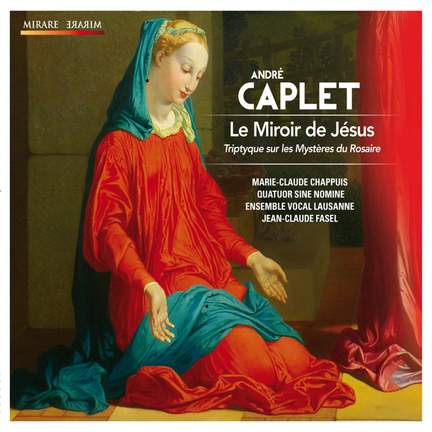
Special offer. Caplet: Le miroir de Jésus
Marie-Claude Chappuis (mezzo), Anne Bassand (harp), Marc-Antoine Bonanomi (double bass)
Ensemble Vocal Lausanne, Quatuor Sine Nomine, Jean-Claude Fasel
The instrumentalists are refinement and rarefaction personified, and the women of the Ensemble Vocal Lausanne sound thoroughly angelic.
Special offer. Caplet: Le miroir de Jésus
Marie-Claude Chappuis (mezzo), Anne Bassand (harp), Marc-Antoine Bonanomi (double bass)
Ensemble Vocal Lausanne, Quatuor Sine Nomine, Jean-Claude Fasel
Purchase product
The instrumentalists are refinement and rarefaction personified, and the women of the Ensemble Vocal Lausanne sound thoroughly angelic.
About
Caplet's mystic 'Le Miroir de Jésus', a setting of poems by Henri Ghéon composed in 1923, is highly unusual in its structure of 15 sections in which the Christian meditates on the mysteries experienced by the Virgin Mary through events in the life of her Son, as if in a 'mirror' of herself. Equally unusual is its scoring: mezzo-soprano, female chorus, harp and string quintet.
André Caplet (1878-1925) was a French composer and conductor now known primarily through his orchestrations of works by Claude Debussy. He won the Prix de Rome in 1901 ahead of Ravel. He became a close friend of Claude Debussy and in 1911 prepared an orchestration of Debussy's 'Children's Corner,' which, along with his orchestration of 'Clair de lune' from the 'Suite bergamasque' is probably the most widely performed and recorded example of his work.
Caplet's own innovative works have been overlooked for the most part. Especially interesting is his instrumental use of voices, as in 'Le Miroir de Jésus', which features a nine-voice "choeur de femmes" in an accompanying role Caplet termed "voix d'accompagnement". The solo vocal line owes something to Mélisande but also to Schoenberg's 'Pierrot Lunaire'. Though unique of its kind 'Le Miroir de Jésus' may nonetheless be seen with hindsight to belong to an eminently French tradition that goes back to Gounod through Fauré, Debussy and Tournemire and foreshadows Messiaen's 'Trois Petits Liturgies de la Présence Divine'. It was premiered by the composer in 1924, in Lyon, with Claire Croiza as soloist. A rare, refined work, for contemplation as much as listening.
Contents and tracklist
- Ensemble Vocal de Lausanne, Jean-Claude Fasel, Marie-Claude Chappuis, Quatuor Sine Nomine, Anne bassand, Marc-Antoine Bonanomi
- Ensemble Vocal de Lausanne, Jean-Claude Fasel, Marie-Claude Chappuis, Quatuor Sine Nomine, Anne bassand, Marc-Antoine Bonanomi
- Ensemble Vocal de Lausanne, Jean-Claude Fasel, Marie-Claude Chappuis, Quatuor Sine Nomine, Anne bassand, Marc-Antoine Bonanomi
Awards and reviews
 May 2013
The instrumentalists are refinement and rarefaction personified, and the women of the Ensemble Vocal Lausanne sound thoroughly angelic.