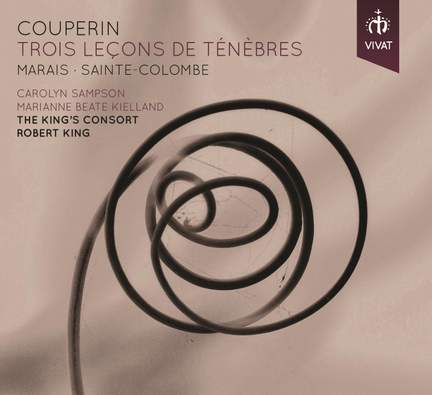
Special offer. Couperin: Trois Leçons de Ténèbres
Carolyn Sampson (soprano), Marianne Beate Kielland (mezzo), Lynda Sayce (theorbo), Robert King (chamber organ), Susanne Heinrich (viol)
King's Consort
The two singers complement each other beautifully in the final setting, Kielland's reedy voice, with its somewhat androgynous quality, throwing Sampson's crystalline soprano into high relief...
Special offer. Couperin: Trois Leçons de Ténèbres
Carolyn Sampson (soprano), Marianne Beate Kielland (mezzo), Lynda Sayce (theorbo), Robert King (chamber organ), Susanne Heinrich (viol)
King's Consort
Purchase product

The two singers complement each other beautifully in the final setting, Kielland's reedy voice, with its somewhat androgynous quality, throwing Sampson's crystalline soprano into high relief...
About
Ravishing second release on The King’s Consort’s new classical label, VIVAT, features world-renowned British soprano Carolyn Sampson and outstanding Norwegian mezzo Marianne Beate Kielland in entrancingly evocative French Baroque music.
Couperin’s three “Leçons” for Holy Week are vividly atmospheric, highly coloured, richly dissonant, and deeply melancholy, presenting music of an intensity that is quiet unique in Baroque sacred repertoire. The third Leçon is an especial jewel, with gloriously intertwining vocal lines.
Alongside the three extraordinary “Leçons” come two further substantial vocal duets by Couperin: a joyous Easter motet and a fine setting of the Magnificat.
Full-length 79’40” disc also includes stunning solo instrumental tracks, with Gramophone award-winning viol player Susanne Heinrich performing music by Marin Marais and Monsieur de Ste-Colombe (composers featured in the film “Tous les Matins du Monde”).
Recorded at “low” French baroque pitch, A=392, giving unparalleled richness to the vocal and instrumental sonorities.
High quality documentation, first-rate engineering.
“The King’s Consort are set to re-enter the recording catalogue” (Gramophone)
Contents and tracklist
- Carolyn Sampson (soprano)
- King's Consort
- Recorded: 5-7 March 2011
- Recording Venue: St. Andrew's Church, Toddington, United Kingdom
- Marianne Beate Kielland (mezzo-soprano)
- King's Consort
- Recorded: 5-7 March 2011
- Recording Venue: St. Andrew's Church, Toddington, United Kingdom
- Carolyn Sampson (soprano), Marianne Beate Kielland (mezzo-soprano)
- King's Consort
- Recorded: 5-7 March 2011
- Recording Venue: St. Andrew's Church, Toddington, United Kingdom
- King's Consort
- Recorded: 5-7 March 2011
- Recording Venue: St. Andrew's Church, Toddington, United Kingdom
- King's Consort
- Recorded: 5-7 March 2011
- Recording Venue: St. Andrew's Church, Toddington, United Kingdom
- Carolyn Sampson (soprano), Marianne Beate Kielland (mezzo-soprano)
- King's Consort
- Recorded: 5-7 March 2011
- Recording Venue: St. Andrew's Church, Toddington, United Kingdom
- Susanne Heinrich (bass viol)
- Recorded: 5-7 March 2011
- Recording Venue: St. Andrew's Church, Toddington, United Kingdom
- Carolyn Sampson (soprano), Marianne Beate Kielland (mezzo-soprano)
- King's Consort
- Recorded: 5-7 March 2011
- Recording Venue: St. Andrew's Church, Toddington, United Kingdom
Awards and reviews
 June 2013
The two singers complement each other beautifully in the final setting, Kielland's reedy voice, with its somewhat androgynous quality, throwing Sampson's crystalline soprano into high relief and adding a slight edginess that prevents the performances from becoming too saccharine.
 May 2013
[Sampson and Kielland] deliver fresh performances that are at once serious, stylish and beautifully judged...Well worth acquiring.
 May 2013
the delightful purity and seeming weightlessness of Sampson's voice, at times soaring ethereally in delicate melismas, is perfectly complemented by the warmer character of the Norwegian mezzo-soprano...The instrumental support for the Lecons is discreet, a model of refined restraint...King's own notes are packed with priceless information and valuable insight.
 2nd July 2013
There is something about the atmosphere of Robert King’s Ténèbres which makes it more believable than many, and this is a recording which will take you on a very long journey indeed...The King’s Consort musicians create the ideal atmosphere for Couperin’s Lamentations, and both vocal soloists are highly effective and deeply expressive.
 10th March 2013
Robert King has always been able to assemble the right people for the right job...he combines the contrasting timbres of Carolyn Sampson (soprano) and Marianne Beate Kielland (mezzo) in sumptuous performances of three works by Couperin. Sampson’s brightness and Kielland’s riper tones beautifully complement each other.
 7th April 2013
Another hit for the King Consort's new label Vivat. The gorgeous Trois leçons de ténèbres...are remarkable for their intertwining, sensual dissonances: here the idiomatic (though not vibrato-free) voices of soprano Carolyn Sampson and mezzo Marianne Beate Kielland are recorded quite close, so the detail tells...the eloquent centrepiece is the third lesson for them both, absolutely spine-tingling in its intensity.
 29th March 2013
Carolyn Sampson and Marianne Beate Kielland [find] liquid lyricism for the vocal arabesques that Couperin weaves around the introductory letters of the Hebrew alphabet...A disc that brings to life a body of music that fully merits the expressive finesse these performers bring to it.
Early Music Today
Carolyn Sampson is perhaps this country’s leading singer of French baroque repertoire, and in Marianne Beate Kielland she has the ideal partner: the two voices weave around and respond to one another with subtlety and flexibility, and the instrumental playing is no less accomplished.