Special offer. Brahms: Works for Solo Piano Volume 2
Barry Douglas (piano)
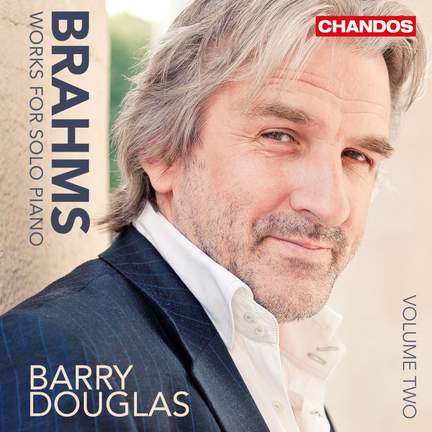
Douglas superbly draws out the contrasts within each piece, bringing out their individual character, but the two ends of the Brahms life spectrum...seem perhaps closer than is entirely comfortable....
Special offer. Brahms: Works for Solo Piano Volume 2
Barry Douglas (piano)
Purchase product

Douglas superbly draws out the contrasts within each piece, bringing out their individual character, but the two ends of the Brahms life spectrum...seem perhaps closer than is entirely comfortable....
About
This is Volume 2 in our series devoted to the works for solo piano by Johannes Brahms, with the acclaimed pianist Barry Douglas. Since winning the Gold Medal at the 1986 Tchaikovsky International Piano Competition in Moscow, Douglas has established a major international career, and his reputation as a pianist and conductor continues to grow.
Brahms wrote his set of four Ballades, Op. 10 (of which Nos 2 and 3 are included on this disc) at the age of twenty-one, and at a time of much personal upheaval. His friend and patron Schumann had attempted suicide and been confined to a sanatorium near Bonn, and Brahms had been thrust into the role of protector and comforter of Schumann’s wife, Clara, while coming to terms with his own strong feelings for her. Reflective of the difficult situation, these Ballades display a deep-felt blend of the dramatic and the lyrical.
A few months before he composed the Ballades, during his stay with the Schumanns in October 1853, Brahms completed a new piano sonata with which he had been struggling throughout the spring and summer of that year. Published as his Sonata No. 3, it would remain his single largest keyboard composition. It unites aspects of his two previous sonatas – the classical features of No. 1 with the romantic, fantasia-like character of No. 2 – and surpasses both of them in virtuosity and structural command.
Brahms’s collections of short piano pieces, issued as Op. 116 – 19, were among his final compositions for piano, and albeit a few of them provide brief glimpses of the old energy and fire, most are reflective, and deeply introspective in character. This was music that Brahms wrote to play for himself, or at the most to a few close friends. In fact, Clara Schumann was the first to see these in their manuscript form.
Contents and tracklist
- Barry Douglas
- Recorded: 12, 13 September 2012
- Recording Venue: West Road Concert Hall, Cambridge, UK
- Barry Douglas
- Recorded: 12, 13 September 2012
- Recording Venue: West Road Concert Hall, Cambridge, UK
- Barry Douglas
- Recorded: 12, 13 September 2012
- Recording Venue: West Road Concert Hall, Cambridge, UK
- Barry Douglas
- Recorded: 12, 13 September 2012
- Recording Venue: West Road Concert Hall, Cambridge, UK
- Barry Douglas
- Recorded: 12, 13 September 2012
- Recording Venue: West Road Concert Hall, Cambridge, UK
- Barry Douglas
- Recorded: 12, 13 September 2012
- Recording Venue: West Road Concert Hall, Cambridge, UK
- Barry Douglas
- Recorded: 12, 13 September 2012
- Recording Venue: West Road Concert Hall, Cambridge, UK
Awards and reviews
 May 2013
Douglas superbly draws out the contrasts within each piece, bringing out their individual character, but the two ends of the Brahms life spectrum...seem perhaps closer than is entirely comfortable. Yet Douglas's pianism is as rewarding as before: his tone is a deep velvet cushion, the legatos full of affection and the rhythms galvanised with great energy.
 17th June 2013
This is another very fine Brahms recital from Barry Douglas. He seems to me to have the measure of the music, whether Brahms is in robust or autumnal mood, and it goes without saying that he has the full technical range to enable him to master the pianistic challenges as well as the interpretative ones.
 31st March 2013
Douglas is particularly successful with [the] B minor Ballade, and in the Sonata No 3 Op 5 written around the same time. There's a tendency towards heaviness in the Ballade Op 10 No 2, but the Intermezzi (Op 116 Nos 2 and 6, Op 117 no 2) and the Rhapsody Op 119 no 4 are handled with skill, perception and dignity.